

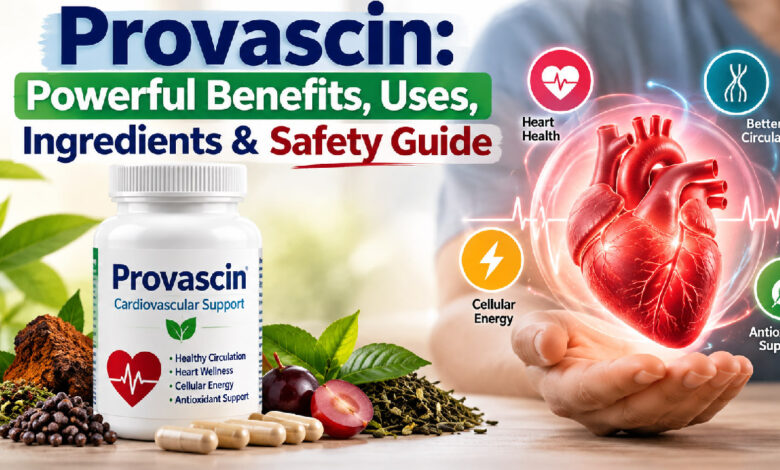
Provascin is a name connected with nutritional supplements and cardiovascular wellness. People often search for Provascin to learn what it is, what ingredients it contains, how it may work, and whether it can support heart and circulatory health. The name can also be confusing because some online articles describe it more like a cardiovascular medicine.
The best-documented information identifies Provascin as a dietary supplement rather than a prescription drug. Historical information connects the product with PURICA and The Nutraceutical Medicine Company Inc. Its formula combined several nutritional and plant-based ingredients instead of relying on one pharmaceutical active ingredient.
Understanding this difference is important. A supplement may contain useful nutrients and compounds, but this does not automatically mean it can prevent or treat a disease. This guide explains Provascin, its history, ingredients, possible benefits, safety concerns, availability, and the limits of the evidence in simple terms.
What Is Provascin?
Provascin is best understood as a nutritional or dietary supplement. Historical records connect the PROVASCIN name with The Nutraceutical Medicine Company Inc., a Canadian company also associated with the PURICA brand. Trademark information describes PROVASCIN in connection with dietary supplements rather than identifying it as a prescription cardiovascular medicine.
The historical product was a multi-ingredient formula. This means it contained several nutritional compounds, antioxidants, and plant-derived ingredients rather than a single drug ingredient. Its formula included ingredients such as L-carnitine, Coenzyme Q10, Chaga, alpha-lipoic acid, grape seed extract, and green tea extract.
Some websites describe Provascin as though it were a medicine for circulation or blood pressure. That description needs caution. Reliable historical documentation supports its identity as a supplement. It should therefore not automatically be considered a treatment for hypertension, high cholesterol, blocked arteries, heart disease, or other cardiovascular conditions.
History and Background of Provascin
The Provascin name has a history going back more than two decades. U.S. trademark records show that The Nutraceutical Medicine Company Inc. filed for the PROVASCIN trademark in January 2003. The goods connected with the trademark were described as dietary supplements, specifically anti-catabolic supplements. The trademark was later registered in the United States.
Provascin also became associated with PURICA, a Canadian natural health brand. PURICA itself has been used for health food supplements, nutraceuticals, vitamins, minerals, amino acids, herbal supplements, and plant extracts. This background helps explain why Provascin appears in older natural-health and supplement listings rather than standard prescription-drug databases.
Historical retailer information also shows Provascin being sold in capsule form. However, old pages can remain visible long after a product becomes difficult to find. Historical listings therefore provide useful information about the product’s past, but they should not automatically be treated as proof of current production or availability.
What Is Provascin Used For?
Provascin was mainly promoted as a nutritional product connected with cardiovascular wellness. Older descriptions associated the formula with circulation, cellular energy, antioxidant activity, metabolism, and general heart and blood-vessel support. These uses fit with several of the ingredients that were included in the historical formula.
For example, L-carnitine and CoQ10 have important roles in normal cellular energy processes. Alpha-lipoic acid and plant compounds found in ingredients such as green tea and grape seed are associated with antioxidant activity. These properties provide some context for why they were combined in a broad wellness formula.
However, the phrase “used for” needs to be understood carefully. Historical marketing purposes are not the same as medically proven indications. There is not strong direct evidence showing that the complete Provascin formula treats hypertension, high cholesterol, heart disease, or arterial blockage. Anyone with a diagnosed cardiovascular condition should follow professional medical advice rather than substitute a supplement for established treatment.
Provascin Ingredients Explained
Historical product information describes Provascin as a formula containing eight main ingredients. These were L-carnitine, alpha-ketoglutaric acid, micronized Chaga, Coenzyme Q10, betaine hydrochloride, DL-alpha-lipoic acid, grape seed extract, and green tea extract. Each ingredient has a different role, so Provascin was not built around one single mechanism.
L-carnitine is naturally present in the body and helps transport fatty acids for use in cellular energy production. CoQ10 is also involved in energy production and has antioxidant properties. Alpha-ketoglutaric acid participates in normal metabolic pathways, while alpha-lipoic acid is involved in metabolism and antioxidant processes.
Chaga is a fungus with a history of traditional use, while grape seed and green tea extracts provide plant compounds such as polyphenols. Betaine hydrochloride was another component of the formula. Research into individual ingredients can help explain the reasoning behind the combination, but it does not prove that the finished Provascin formula produces the same effects found in studies of individual ingredients.
How Does Provascin Work?
There is no single simple mechanism that explains Provascin because the historical product contained several different ingredients. The formula appears to have been designed around a combination of cellular energy, metabolism, antioxidant activity, and general nutritional support rather than one specific pharmaceutical action.
L-carnitine helps the body transport fatty acids to areas of cells where they can contribute to energy production. CoQ10 is involved in mitochondrial energy processes. Alpha-ketoglutaric acid also participates in metabolic pathways used by cells. Together, these ingredients explain the formula’s historical connection with energy and metabolic wellness.
Other components, including alpha-lipoic acid, grape seed extract, green tea extract, and compounds present in Chaga, are associated with antioxidant activity. Antioxidants help address oxidative processes in the body, but this biological role should not be confused with proven disease treatment. Knowing how individual ingredients function does not establish that Provascin itself prevents or treats cardiovascular disease.
Potential Benefits of Provascin
The possible benefits of Provascin are mainly connected with its ingredients and the purposes for which the supplement was historically promoted. The formula brought together compounds associated with cellular energy, metabolism, antioxidant activity, and general cardiovascular wellness. This combination may explain why Provascin was positioned as a broad nutritional product.
L-carnitine and CoQ10 are particularly relevant to cellular energy. Alpha-lipoic acid has antioxidant and metabolic roles, while grape seed and green tea contain plant compounds that have received research attention. Chaga also contains naturally occurring compounds that have been investigated for biological activity.
These points should be described as potential nutritional benefits rather than guaranteed health outcomes. Research involving one ingredient cannot automatically be applied to the complete supplement. There is not strong direct evidence showing that Provascin itself reliably lowers cholesterol or blood pressure, prevents heart attacks, clears blocked arteries, or treats cardiovascular disease. Those are medical outcomes requiring much stronger evidence.
Is Provascin Effective?
Whether Provascin is effective depends first on what someone expects it to do. Several ingredients in its historical formula have been studied separately. CoQ10, L-carnitine, alpha-lipoic acid, grape seed compounds, and green tea compounds all have scientific literature examining different biological and health effects.
The important limitation is that ingredient research is not the same as research on Provascin itself. A scientific study may use a much larger amount of an ingredient, a different chemical form, or a specific group of patients. The results cannot simply be transferred to a multi-ingredient supplement containing different amounts.
For this reason, Provascin is better described as a nutritional support formula than as a clinically proven cardiovascular treatment. Personal reviews also cannot establish effectiveness. Someone’s health may change because of medication, diet, physical activity, sleep, or other factors. Without strong product-specific clinical studies, it is difficult to establish exactly what effects Provascin produces or how quickly they occur.
Provascin and Blood Pressure
Provascin is sometimes discussed online in connection with blood pressure and improved circulation. This can create the impression that it is an established hypertension medicine. However, cardiovascular-support claims and the medical treatment of high blood pressure are two very different things.
Blood pressure medicines normally contain clearly identified pharmaceutical ingredients with known doses and mechanisms. Depending on the patient, established treatment can include medicines from classes such as ACE inhibitors, angiotensin receptor blockers, calcium channel blockers, or diuretics. Provascin’s historical formula instead consisted of nutritional and plant-derived ingredients.
There is not enough strong direct evidence to state that the complete Provascin formula reliably lowers high blood pressure. Even if an individual ingredient has been studied for cardiovascular effects, that evidence cannot automatically prove that Provascin treats hypertension. People diagnosed with high blood pressure should not stop, reduce, or replace prescribed medicine because they begin using a nutritional supplement.
Provascin Dosage and How to Take It
Historical Provascin listings have included directions for taking the capsules, but older instructions should not automatically be treated as appropriate advice for a product found today. Supplements can change over time, and two products using a similar name may not necessarily contain the same ingredients or amounts.
The safest source for serving information is the label attached to the exact product being considered. The label should identify the serving size, ingredient quantities, warnings, manufacturer, and any specific directions. Taking additional capsules should not be assumed to produce greater benefits, because increasing a dose can also increase unwanted effects.
People should be especially careful when combining Provascin with other supplements. Different products can contain overlapping ingredients, increasing the total amount consumed without the person realizing it. Anyone using prescription medication or managing an existing medical condition should discuss a multi-ingredient supplement with a doctor or pharmacist before adding it to their routine.
Provascin Side Effects
A multi-ingredient supplement such as Provascin can potentially cause unwanted effects even when its ingredients are described as natural or nutritional. A person’s reaction can depend on the amount taken, individual sensitivity, existing medical conditions, medications, and other supplements being used at the same time.
Possible concerns associated with ingredients found in nutritional formulas can include digestive discomfort, nausea, headache, or sensitivity reactions. Certain ingredients may also influence biological processes such as blood sugar regulation. Concentrated plant extracts deserve particular attention because taking an extract is not necessarily equivalent to consuming the plant in an ordinary food or drink.
There is not enough product-specific evidence to provide a complete and definitive list of Provascin side effects. This uncertainty makes the actual product label important. Anyone who experiences a significant or unexpected reaction after taking a supplement should stop relying on online descriptions and seek appropriate medical advice, particularly if the symptoms are serious or persistent.
Drug Interactions and Safety Precautions
Provascin contains several biologically active ingredients, which means possible interactions should be considered. This is especially important for people taking several prescription medicines. The risk depends on the exact Provascin formula, ingredient amounts, medication being used, and the person’s health.
Additional caution may be appropriate for people using anticoagulants or antiplatelet medicines, as well as medicines for blood pressure or diabetes. People with cardiovascular, liver, kidney, metabolic, or other significant medical conditions should also avoid assuming that a nutritional supplement is automatically safe simply because it can be purchased without a prescription.
Pregnant or breastfeeding people should seek professional advice before using an unfamiliar multi-ingredient supplement. The same principle applies when several supplements are taken together because formulas may contain overlapping substances. When discussing Provascin with a doctor or pharmacist, showing the full ingredient label is more useful than providing only the product name because the professional can evaluate the individual components and amounts.
Is Provascin FDA Approved?
Provascin should not be described as an FDA-approved medicine for hypertension, high cholesterol, heart disease, or another cardiovascular condition. Historical U.S. trademark documentation identifies PROVASCIN in connection with dietary supplements. This distinction matters because dietary supplements and prescription drugs follow different regulatory pathways.
Prescription drugs generally require evidence supporting their safety and effectiveness for approved medical indications before they can be marketed as treatments. Dietary supplements are regulated differently and do not receive the same type of premarket approval for effectiveness. Therefore, finding a supplement legally offered for sale does not mean it has been FDA approved to treat a disease.
At the same time, lack of FDA drug approval should not automatically be interpreted as meaning every supplement is illegal or unsafe. It simply means readers must distinguish nutritional products from approved medicines. Claims that Provascin cures cardiovascular disease, treats hypertension, or replaces prescription therapy would require appropriate clinical and regulatory evidence rather than relying on its status as a supplement.
Is Provascin Still Available?
Provascin clearly has a documented history as a supplement name, but its present retail availability is less straightforward. Historical information describes capsule products, including older retailer listings that may continue appearing in search results. Such pages can remain online even when a retailer has stopped carrying a particular product.
For this reason, an old Provascin sales page should not automatically be considered evidence that newly manufactured stock remains widely available. Product names can also be reused or appear on third-party websites, making it important to identify the manufacturer and formula rather than relying only on the name printed in a listing.
Anyone who finds Provascin today should check when the product was manufactured, its expiry date, manufacturer details, ingredient label, lot information, package condition, and seller. A product that contains completely different ingredients should not automatically be considered equivalent to the historical formula. Current availability and authenticity should therefore be verified before purchase rather than assumed from older online references.
What to Check Before Buying or Using Provascin
Before buying Provascin, the most important step is confirming exactly what product is being offered. The manufacturer’s name, complete ingredient list, serving size, ingredient amounts, expiry date, lot or batch information, safety warnings, and package seal should all be clearly visible. Missing information deserves caution.
It is also important to examine the claims being made by the seller. Statements promising to cure heart disease, permanently lower blood pressure, remove arterial blockages, or replace prescription cardiovascular medicines should not be accepted simply because they appear on a product page. Strong medical claims require strong clinical evidence.
People who already use medication should consider the formula rather than only the brand name. A doctor or pharmacist can review individual ingredients for possible interactions. Buyers should also remember that customer reviews are mainly personal experiences. They may provide information about packaging, taste, capsule size, or delivery, but they cannot establish that a supplement successfully treats a medical condition.
Frequently Asked Questions
What is Provascin?
Provascin is best documented as a nutritional supplement associated with cardiovascular wellness. Its historical formula contained several ingredients linked with cellular energy, metabolism, and antioxidant activity rather than a single pharmaceutical drug ingredient.
What is Provascin used for?
Provascin was historically promoted for cardiovascular wellness, circulation, cellular energy, metabolism, and antioxidant support. These uses do not mean that Provascin has been proven to treat heart disease, high blood pressure, or high cholesterol.
What ingredients are found in Provascin?
The historical Provascin formula included L-carnitine, alpha-ketoglutaric acid, Chaga, CoQ10, betaine hydrochloride, alpha-lipoic acid, grape seed extract, and green tea extract. Ingredients should always be checked on the current product label.
Does Provascin help with high blood pressure?
There is not enough strong product-specific evidence to confirm that Provascin treats high blood pressure. People with hypertension should follow their prescribed treatment and speak with a healthcare professional before adding Provascin or another supplement.
Is Provascin safe to use?
Provascin may not be suitable for everyone because it contains several active ingredients. Safety can depend on the formula, dosage, medical conditions, and medications being taken. A doctor or pharmacist can provide individual guidance.





One Comment