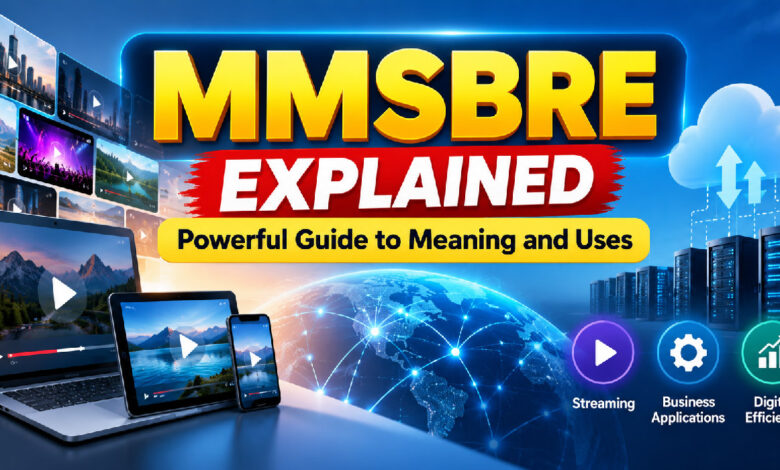
MMSBRE is an emerging digital term that has gained attention across websites, search results, technology discussions, and business-focused content. The term is unusual because it does not currently have one universally accepted definition. Different online sources connect MMSBRE with multimedia streaming, broadcasting, business efficiency, resource management, digital infrastructure, artificial intelligence, security, and business resilience.
One reported interpretation expands MMSBRE as Multi-Media Streaming and Broadcast Relay Environment. Under this meaning, MMSBRE describes a connected environment that may receive multimedia, process it, prepare it for online delivery, distribute it across different platforms, protect access, and monitor performance. It can therefore be discussed alongside established technologies used for video streaming and digital broadcasting.
Another interpretation presents MMSBRE as a broader business and digital concept focused on improving workflows, managing resources, building scalable systems, using data effectively, and creating better customer experiences. Because these interpretations are very different, MMSBRE should currently be treated as an emerging and context-dependent term rather than an established global standard.
What Is MMSBRE?
MMSBRE is an emerging term used in different ways across online content. Some descriptions focus heavily on multimedia technology, while others connect the term with business operations and digital transformation. There is currently no single verified definition that can accurately describe every use of MMSBRE across different websites and industries.
In a multimedia context, MMSBRE may describe an environment where video, audio, captions, graphics, metadata, and other digital media are captured, processed, distributed, and monitored. Such an environment could involve multiple technologies working together instead of relying on one application or device to perform every function.
In a business context, MMSBRE is associated with using people, money, software, equipment, information, and time more efficiently. Businesses can review their existing workflows, identify waste, improve digital systems, use meaningful data, and design processes that remain manageable as the organization grows.
What Does MMSBRE Stand For?
One reported expansion of MMSBRE is Multi-Media Streaming and Broadcast Relay Environment. This interpretation is mainly connected with multimedia delivery and digital broadcasting. However, this full form should not be presented as a universally established definition because there is no confirmed standards organization identified in the supplied information that officially defines MMSBRE this way.
“Multi-Media” can refer to several types of digital content, including video, audio, captions, graphics, interactive material, and metadata. “Streaming” describes the continuous delivery of media through a network, allowing people to watch or listen without downloading an entire file before playback begins.
“Broadcast Relay” can describe receiving a media feed and forwarding or preparing it for additional destinations. “Environment” suggests that the concept covers a complete setup involving hardware, software, network services, security controls, monitoring systems, and people rather than referring to one individual streaming technology.
Why Does MMSBRE Have Different Meanings?
MMSBRE is difficult to define because there does not appear to be one recognized source controlling its meaning. Established technologies normally have documentation, standards, specifications, or identifiable organizations behind them. The information currently associated with MMSBRE does not provide the same level of consistency.
Some sources discuss multimedia streaming and broadcast relay environments. Other descriptions focus on workflow efficiency, resource management, digital infrastructure, and customer experience. Additional interpretations have connected the acronym with artificial intelligence, resilience, prediction, security, and other areas of digital technology.
These descriptions should not automatically be combined into one system. Multimedia streaming, business process management, AI, and cybersecurity are different disciplines. Until reliable documentation establishes a connection between them, readers should identify the context in which MMSBRE appears before deciding what the term means.
The Main Interpretations of MMSBRE
The multimedia interpretation is one of the most detailed ways MMSBRE is described. Under this model, the concept covers a path that begins with a multimedia source and continues through processing, encoding, packaging, distribution, playback, security, and performance monitoring.
The business interpretation takes a different approach. Instead of focusing on media delivery, it concentrates on business efficiency. Its main themes include reducing unnecessary work, managing resources effectively, improving workflows, choosing scalable technology, using data for decisions, and improving customer experiences.
Other interpretations exist, but the available information does not demonstrate that they form parts of one standardized MMSBRE model. This distinction is important because readers should not assume that every website using the same acronym is necessarily discussing the same technology or methodology.
How MMSBRE Could Work in Multimedia Streaming
Under the multimedia interpretation, MMSBRE can be understood as a complete environment connecting the original media source with the final viewer. A basic process could move from media capture to ingest, encoding, packaging, an origin system, distribution, playback, and monitoring.
The process could begin with a camera, microphone, screen share, recorded video, studio feed, or another source. An ingest system receives the original media and sends it into the processing environment. Important broadcasts may also use backup sources or connections to reduce the impact of technical failures.
The media then needs to be prepared for efficient online delivery. Encoding, packaging, relay services, content delivery networks, media players, security controls, and monitoring tools can all contribute to the process. MMSBRE in this context is therefore better understood as an environment rather than one individual streaming application.
Media Capture and Ingest
Media capture is the starting point of a streaming workflow. Cameras can capture video, microphones can capture sound, and computers can provide screen recordings or digital presentations. Professional environments may combine several sources to create one complete live or recorded production.
Ingest refers to bringing this source media into the streaming environment. A stable connection is especially important for live content because interruptions at the beginning of the workflow can affect every later stage. Some systems may therefore use additional connections or backup feeds.
A useful backup should not depend completely on the same infrastructure as the primary feed. If both connections rely on the same failing network or power source, the backup may provide little protection. Redundancy must therefore be designed and tested rather than simply added.
Encoding and Transcoding
Raw multimedia files can require large amounts of data, making them difficult to distribute efficiently over the internet. Encoding converts video or audio into a compressed digital format that is more suitable for storage, transmission, and playback across different devices.
A streaming environment can create several versions of the same content at different quality levels. Someone using a strong internet connection may receive a higher-quality stream, while another viewer with limited bandwidth may receive a smaller version requiring less data.
This process supports adaptive streaming. A compatible player can move between available quality levels when network conditions change. The purpose is to maintain playback while balancing picture quality and connection performance, reducing unnecessary interruptions when bandwidth becomes unstable.
Packaging, Origin, and Media Delivery
After encoding, content needs to be prepared for delivery. Packaging can organize the encoded media into formats that compatible players understand. Established technologies such as HLS, MPEG-DASH, and CMAF may be used within modern streaming workflows depending on the system.
An origin system makes the required media available for distribution. This can include video segments, manifests, captions, audio tracks, and metadata. Depending on the service, the same environment may also support recorded playback, advertising functions, encryption, or converting live programming into on-demand content.
These technologies should not be described as technologies created by MMSBRE. They already have their own established roles. Under the proposed multimedia interpretation, they would simply be components that could operate inside a broader source-to-viewer media environment.
Relay, CDN, and Multi-Platform Distribution
Relay and distribution become important when media must reach multiple destinations. A single source may need to appear on a website, mobile application, smart television platform, social service, private company portal, or another digital destination.
A Content Delivery Network, commonly called a CDN, can help distribute digital content through infrastructure located closer to different groups of users. This reduces pressure on the original server and can improve content delivery when audiences are geographically distributed or particularly large.
A CDN should not be considered identical to MMSBRE. A CDN primarily supports content distribution. An MMSBRE-style multimedia environment may include capture, encoding, packaging, security, monitoring, playback, and other functions in addition to using a CDN for delivery.
Playback and Viewer Experience
Playback is where the technical streaming process becomes visible to the audience. A media player receives the prepared stream and presents video or audio to the viewer. Modern players may automatically select a suitable quality level according to network conditions and device capabilities.
Viewer experience depends on more than picture quality. Startup time, buffering, playback failures, audio quality, captions, device compatibility, and stream stability can all influence whether people have a positive experience with an online broadcast.
This is why the complete delivery path matters. A stream can appear healthy on one server while viewers still experience problems elsewhere. Effective multimedia operations should therefore examine actual user experience rather than relying exclusively on basic server availability.
Security and Monitoring
Security requirements depend on the content being distributed. Public streams may need relatively simple controls, while paid, private, or sensitive content can require authentication, authorization, signed links, encryption, digital rights management, activity records, or other protective measures.
Monitoring helps operators understand whether the system is performing properly. Useful measurements can include startup time, buffering, playback errors, delivery delay, encoding failures, concurrent viewers, stream quality, and performance across different devices or geographic locations.
End-to-end monitoring can also make troubleshooting easier. A streaming failure might originate from the source, encoder, origin infrastructure, CDN, network, or media player. Monitoring different stages helps technical teams identify where the problem started instead of guessing.
MMSBRE as a Business Efficiency Concept
A separate interpretation of MMSBRE focuses on business efficiency and digital operations. Under this approach, organizations examine how employees, technology, budgets, equipment, information, and other resources are being used and identify opportunities for improvement.
Efficiency does not simply mean reducing spending. Cutting costs can create additional problems when it damages quality, employee productivity, system reliability, or customer service. Effective resource management instead attempts to generate useful outcomes while reducing unnecessary work, delays, duplication, and waste.
The business interpretation should currently be treated separately from the multimedia interpretation. There is no confirmed evidence in the supplied information demonstrating that both definitions originated from one official MMSBRE framework or were designed by the same organization.
MMSBRE and Better Business Workflows
A business workflow describes how work moves from one stage to another. Complicated workflows can contain repeated data entry, unnecessary approvals, unclear responsibilities, duplicated software, and other steps that consume time without creating enough value.
Organizations can map existing processes from beginning to end and identify bottlenecks. Unnecessary steps can then be removed, responsibilities clarified, and repeated activities standardized. Automation can be considered after the underlying workflow has been properly understood and improved.
Automating a poorly designed process does not necessarily solve its problems. It may simply make an inefficient process operate faster. A more practical sequence is to understand the problem, simplify the process, standardize important steps, automate appropriate activities, and measure the final results.
Smarter Resource Management
Every organization operates with limited resources. Employee time, budgets, software subscriptions, equipment, office space, information, and technical infrastructure all have costs. Effective management requires understanding where these resources are being used and what value they create.
For example, an organization may discover that multiple software products perform nearly identical tasks. Employees may also spend significant time manually moving information between disconnected systems. Identifying these problems can help management decide where consolidation, integration, or process improvement would provide value.
The cheapest solution is not automatically the most efficient. An inexpensive platform can become costly when it creates additional manual work, frequent failures, or difficult migrations. Resource decisions should therefore consider immediate costs, long-term requirements, productivity, reliability, and expected business growth.
Digital Infrastructure and Scalability
Businesses increasingly depend on digital infrastructure for communication, payments, customer information, project management, analytics, file storage, marketing, and daily operations. Reliable infrastructure helps these activities function consistently while making information easier for authorized employees to access.
Scalability describes a system’s ability to support growth. A tool suitable for ten employees may become difficult to manage when hundreds of people use it. Similar problems can occur when customer numbers, transactions, files, traffic, or data volumes increase.
A scalable approach does not require purchasing the largest available system. Businesses should select technology suitable for current requirements while providing reasonable capacity for future expansion. Cloud services, integrated software, secure access, and cleaner data flows may support this objective when appropriately implemented.
Data-Driven Decisions and MMSBRE
Data can help organizations understand what is happening instead of relying entirely on assumptions. Sales figures, operating costs, processing times, customer behavior, workloads, support requests, and retention data can reveal patterns that may otherwise remain unnoticed.
More data does not automatically produce better decisions. Large dashboards filled with unrelated measurements can make important information harder to identify. Organizations should select a smaller number of meaningful metrics connected directly to defined business objectives.
Data becomes valuable when it supports action. A measurement should help a team decide what needs improvement, what should continue, what should stop, or what requires further testing. The business interpretation of MMSBRE therefore emphasizes purposeful information rather than collecting data simply because technology makes collection possible.
Customer Experience and MMSBRE
Internal efficiency should not create unnecessary difficulties for customers. A business may make an internal process faster while accidentally introducing confusing forms, slower support, complicated account requirements, or poor website experiences for the people it serves.
Customer feedback can reveal these problems. Support requests, complaints, user behavior, abandoned processes, conversion data, and direct feedback can help organizations identify where customers experience difficulty and determine which parts of their journey require improvement.
Customer-focused development means evaluating operational changes from both perspectives. A successful improvement should support the organization while also making interactions clear, reliable, and convenient for customers. Efficiency and customer satisfaction should therefore complement rather than compete with each other.
MMSBRE and Automation
Automation can reduce repetitive work when it is applied to appropriate processes. Routine notifications, data movement, reporting, scheduling, and other predictable activities may require less manual effort when suitable automated systems are introduced.
However, automation should follow process analysis rather than replace it. If responsibilities are unclear or information is inaccurate, automating the workflow can reproduce those weaknesses at a greater scale. Organizations should first understand what the process is supposed to accomplish.
The strongest approach is to identify the problem, remove unnecessary steps, establish clear responsibilities, and then determine whether automation provides measurable value. Technology should support the business objective rather than becoming the objective itself.
Is MMSBRE Related to Artificial Intelligence?
Some online interpretations connect MMSBRE with artificial intelligence, but AI should not currently be presented as a confirmed or required component of MMSBRE. The available descriptions do not establish one official MMSBRE architecture that requires artificial intelligence.
AI could theoretically support some activities associated with the term. In multimedia systems, it may assist with automated analysis, captions, quality checks, monitoring, or content processing. In business operations, AI can potentially support prediction, automation, data analysis, and customer service.
These potential applications do not prove that MMSBRE is an AI framework. Artificial intelligence is better viewed as one technology that could support certain multimedia or business functions rather than evidence for a particular definition of MMSBRE.
Common Uses of MMSBRE
Under the multimedia interpretation, an MMSBRE-style environment could potentially support live events, sports broadcasts, webinars, online education, company meetings, employee training, news, creator content, product launches, and other digital video services.
One source could potentially be prepared for several destinations, allowing audiences to watch through websites, mobile applications, television applications, social platforms, or private systems. Security and access controls could also be introduced where content is limited to selected viewers.
Under the business interpretation, possible applications include workflow improvement, resource allocation, process automation, digital transformation, scalable infrastructure, data-supported decision making, and customer experience improvement. These are applications of the ideas associated with MMSBRE rather than confirmed features of one official product.
Benefits Associated With MMSBRE
Potential multimedia benefits include centralized media processing, distribution across multiple platforms, better monitoring, adaptable stream quality, and improved operational visibility. Properly designed backup systems can also improve reliability when individual components experience failures.
Business-focused benefits may include clearer workflows, less repetitive work, more effective resource allocation, scalable technology, and better use of operational data. Organizations may also find it easier to connect strategic goals with everyday processes when responsibilities and measurements are clearly defined.
These benefits should not be treated as guaranteed results of adopting something called MMSBRE. Since the term lacks a fixed standard, results depend on the actual technologies, processes, employees, planning, implementation quality, and measurements used by an organization.
Challenges and Limitations of MMSBRE
The biggest limitation is the absence of one widely recognized definition. Without an established specification, two organizations could use MMSBRE to describe completely different concepts. This creates uncertainty for readers, businesses, and technical professionals researching the term.
Multimedia environments can also become expensive and complex. Encoding, bandwidth, storage, CDN delivery, monitoring tools, security systems, software subscriptions, technical staff, and backup infrastructure can increase operational costs. More components can additionally create more potential points of failure.
Business implementations face different risks. Organizations can purchase unnecessary software, automate poor workflows, collect excessive data, or introduce systems employees find difficult to use. Technology creates value only when it addresses clearly identified operational or customer problems.
Is MMSBRE a Recognized Standard?
Based on the supplied information, MMSBRE should not currently be described as a universally recognized industry standard, protocol, or formal technology category. No confirmed standards organization has been identified as maintaining one authoritative MMSBRE specification.
This distinction matters because established standards normally have clearer definitions and documentation. Technologies such as HLS and MPEG-DASH have specific technical purposes, while CDN, OTT, and video conferencing are established industry terms with generally understood meanings.
MMSBRE is better described as an emerging and ambiguous digital term. It may become more clearly defined if an organization, industry, or community consistently adopts one meaning, but current information does not justify presenting one interpretation as universally official.
Who Created MMSBRE?
No confirmed individual, company, developer, research institution, or standards organization has been established as the original creator of MMSBRE in the information available for this article. Claims identifying an origin should therefore be treated carefully unless reliable primary documentation supports them.
The lack of a confirmed creator helps explain why definitions vary. Different websites can repeat or expand an interpretation without demonstrating where that definition originally came from. Repetition across multiple pages does not necessarily establish an authoritative source.
Readers researching MMSBRE should look for original documentation, identifiable organizations, technical specifications, research papers, verified products, or real implementation examples. Strong evidence is more useful than the number of websites repeating the same unsupported claim.
MMSBRE vs. Established Streaming Technologies
MMSBRE should not be used as another name for established technologies. HLS, for example, is used for HTTP-based media delivery, while MPEG-DASH is an adaptive streaming standard. These technologies have more specific technical roles than the broad MMSBRE interpretations.
A CDN mainly helps distribute digital content across infrastructure in different locations. An OTT platform delivers media over the internet and can contain several streaming components. Video conferencing systems focus heavily on real-time communication between participants.
The proposed multimedia meaning of MMSBRE is broader because it describes an overall environment containing multiple components. Those established technologies could theoretically operate inside such an environment, but they should retain their existing names and technical definitions.
How to Evaluate MMSBRE Claims
Whenever a website, service, or company mentions MMSBRE, readers should first determine exactly how that source defines the term. A technical-looking acronym should not automatically be assumed to represent an official technology or recognized industry standard.
Reliable evaluation involves looking for original documentation, an identifiable developer or organization, technical specifications, independent references, real-world implementations, research, and evidence supporting the claimed benefits. Commercial claims should also explain what underlying technologies actually provide the advertised functions.
Multiple websites repeating the same definition are not automatically independent confirmation. The strongest approach is to trace a claim back to its source whenever possible and judge the underlying technology or methodology on evidence rather than relying on the acronym alone.
Best Practices for Using MMSBRE Principles
For multimedia projects, begin by defining the audience, devices, expected viewer numbers, geographic locations, security requirements, accessibility needs, and acceptable latency. Map the complete path from media capture through processing and distribution to the viewer.
Use established streaming technologies where appropriate, test backup systems, monitor actual viewer experience, protect sensitive content, and avoid unnecessary dependence on proprietary technology. Every additional component should solve a defined technical or operational requirement.
For business applications, start with a specific problem rather than immediately buying new technology. Map existing workflows, remove unnecessary complexity, select meaningful measurements, introduce automation carefully, monitor customer impact, and scale successful improvements only after their value has been demonstrated.
Future of MMSBRE
The future of MMSBRE as a term remains uncertain because its definition is not standardized. It could develop a clearer meaning if companies, developers, researchers, or digital communities begin consistently using the acronym for one particular concept.
The technologies associated with its multimedia interpretation will continue developing regardless of what happens to the MMSBRE name. Cloud-based streaming, multi-platform distribution, lower latency, real-time analytics, automated monitoring, captions, personalization, and smarter routing are already relevant areas of digital media development.
The same applies to its business interpretation. Organizations will continue improving workflows, adopting automation, using cloud systems, analyzing data, managing resources, and improving customer experiences. These practices remain relevant even if MMSBRE never develops into a formally recognized business framework.
Conculsion
MMSBRE is an emerging digital term with several competing interpretations and no single universally verified meaning. One reported expansion is Multi-Media Streaming and Broadcast Relay Environment, describing a broad environment for capturing, processing, distributing, securing, playing, and monitoring digital media.
Other sources associate MMSBRE with business efficiency, resource management, digital infrastructure, customer experience, automation, artificial intelligence, resilience, and security. Current information does not demonstrate that all these ideas form one official framework, product, or standard.
The most accurate way to understand MMSBRE is therefore through context. Readers should determine what a particular source means by the acronym, examine the actual technologies or business methods involved, and look for reliable documentation before accepting broad claims. The concepts associated with MMSBRE can be useful, but their value should be judged on evidence rather than the name itself.
Frequently Asked Questions
What is MMSBRE?
MMSBRE is an emerging digital term with several online interpretations. It is commonly associated with multimedia streaming and broadcasting or with business efficiency, digital systems, resource management, and workflow improvement.
What does MMSBRE stand for?
One reported expansion is Multi-Media Streaming and Broadcast Relay Environment. However, this full form is not established in the supplied information as a universally recognized or officially standardized definition.
Is MMSBRE an official technology standard?
No recognized universal MMSBRE standard is established in the information available for this article. It should currently be treated as an emerging and context-dependent term.
Who created MMSBRE?
There is no confirmed creator, company, developer, research institution, or standards organization established as the original creator of MMSBRE in the supplied information.
Is MMSBRE a software product?
MMSBRE should not automatically be described as one specific software product. Under its multimedia interpretation, it is better understood as a possible environment containing multiple technologies and services.
Is MMSBRE related to streaming?
Yes, one reported interpretation connects MMSBRE with multimedia streaming and broadcast relay environments. However, readers should remember that other online sources use MMSBRE in completely different business and digital contexts.
Is MMSBRE the same as a CDN?
No. A CDN primarily helps distribute content, whereas the proposed multimedia interpretation of MMSBRE covers a broader environment that could include capture, encoding, packaging, distribution, security, playback, and monitoring.
What is MMSBRE used for in business?
Under the business interpretation, MMSBRE is associated with workflow improvement, resource management, digital infrastructure, scalability, automation, data-supported decisions, and better customer experiences.
Is MMSBRE related to AI?
Some descriptions connect MMSBRE with artificial intelligence, but AI is not established as a required component. AI could support certain media or business processes without defining MMSBRE itself.
Is MMSBRE legitimate?
The ideas associated with MMSBRE can involve legitimate technologies and business practices, but MMSBRE itself does not currently have one universally established definition. Any specific MMSBRE claim should therefore be evaluated using its context and supporting evidence.