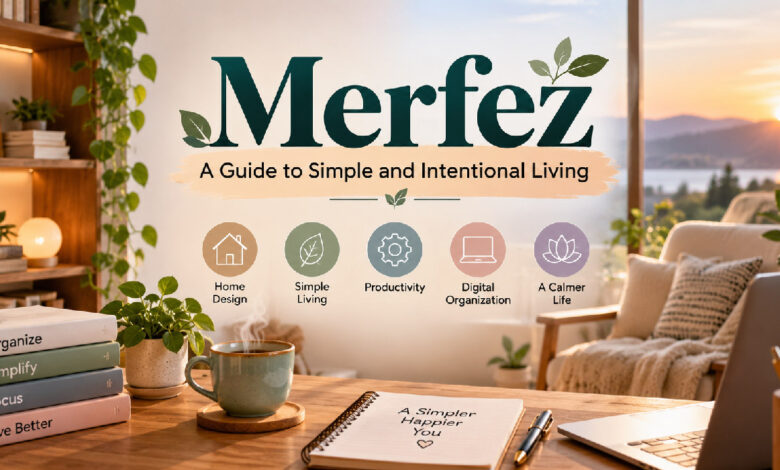
Merfez is an emerging online term connected with simplicity, focus, organization, warm design, and intentional choices. It appears in discussions about lifestyle, home interiors, productivity, creative work, and digital organization. However, the meaning can change depending on where the word is used.
Unlike an established lifestyle philosophy, Merfez does not have one official definition or a fixed set of rules. Different websites explain the idea in different ways. Some focus mainly on calm homes, while others connect it with better work habits, simpler digital systems, or meaningful daily choices.
The most useful way to understand Merfez is as a flexible idea built around reducing unnecessary noise while keeping what adds purpose, comfort, or value. It is not about creating an empty life. Instead, it encourages people to organize their surroundings, attention, and routines around the things that truly matter.
What Is Merfez?
Merfez can be described as a modern online concept centered on purposeful simplicity. The idea is to remove unnecessary clutter, distractions, and complexity while keeping things that are useful, meaningful, comfortable, or important. This basic principle can be applied to homes, workspaces, routines, and digital systems.
In a home, Merfez may mean keeping furniture and objects that serve a real purpose while removing things that only create visual clutter. At work, it can mean using fewer tools and focusing on the tasks that deserve the most attention. In digital life, it can involve organizing files and reducing duplicate apps.
Merfez should still be understood carefully because it is not a formal philosophy. The word can also appear as a brand, website, or publishing name. For this reason, readers should always consider the context before assuming that every mention of Merfez refers to exactly the same idea.
What Does Merfez Mean?
The most common modern interpretation of Merfez is intentional simplicity with warmth. It does not ask people to remove everything that is unnecessary in the strictest sense. Instead, it encourages them to think carefully about why an object, task, habit, or tool deserves space in their life.
Purpose plays an important role. A chair may stay because it is comfortable. A family photograph may stay because it has emotional meaning. A work tool may stay because it saves time. Merfez focuses on value rather than simply reducing the number of possessions or activities.
This approach also includes organization and focus. A room should be easy to use, a schedule should not feel overloaded, and a digital system should help rather than confuse the user. The main idea is simple: keep what improves daily life and reduce what creates unnecessary noise, stress, or complexity.
Is Merfez a Real Word?
Merfez is a real term in the sense that it is used and searched online. However, it is not widely established as a standard English dictionary word with one accepted definition. Its meaning is still developing because different writers and websites use the word in different ways.
This is common on the internet. New terms may begin as brand names, usernames, project titles, website names, or invented expressions. Over time, people may connect these words with certain ideas. Their meanings can become broader as more articles, discussions, and searches appear around them.
Merfez seems to follow this pattern. It has been linked with lifestyle, home design, productivity, technology, creativity, and organization. This does not make the term meaningless. It simply means readers should avoid treating one explanation as the only official definition. Context remains important when deciding what Merfez means in a particular article or discussion.
Where Did the Term Merfez Come From?
The exact origin of Merfez is unclear. There is no widely documented creator, first recorded use, or official source that clearly explains where the modern term began. This uncertainty is one reason different websites have developed their own explanations of its possible background.
Some online discussions connect Merfez with the Turkish word “merkez,” which means center or central point. This connection may appear logical because many descriptions of Merfez focus on choosing a clear center, such as an important goal, useful object, or main purpose, and organizing other things around it.
However, similar spelling alone does not prove a direct linguistic relationship. Merfez can also be confused with other similar-looking words, including “menfez.” Without reliable linguistic evidence, these connections should remain theories rather than established facts. The safest conclusion is that the exact origin of Merfez has not yet been clearly confirmed.
Why Merfez Has Different Meanings Online
Merfez has several meanings because it is still a loosely defined internet term. No recognized organization controls the definition, and there is no official rulebook that determines how the word must be used. This allows different publishers to interpret it according to their own topics and audiences.
One website may describe Merfez as a lifestyle concept based on simple living. Another may connect it with interior design, work habits, technology, creativity, or digital organization. The same word can therefore appear in several different types of articles without those uses necessarily coming from one original system.
Online repetition can also create confusion. When one website suggests a meaning and other publishers repeat it, that explanation may start to look established even when strong evidence is limited. Readers should separate confirmed information from interpretation. Several websites repeating a statement does not automatically prove that the statement represents the official meaning or history of Merfez.
Merfez as a Lifestyle Idea
As a lifestyle idea, Merfez is mainly connected with purposeful simplicity. It encourages people to pay attention to what they own, how they use their time, and which activities deserve their energy. The goal is not to live with almost nothing but to remove what no longer adds useful value.
A person following this approach may keep books, photographs, artwork, furniture, tools, and handmade objects because these items are useful or meaningful. At the same time, they may remove unused possessions, unnecessary subscriptions, repeated tasks, or habits that make daily life more complicated without providing a clear benefit.
Merfez can also influence everyday routines. A person may protect time for one important task, reduce unnecessary commitments, or create a simple place for frequently used items. The idea remains flexible. There is no official amount of clothing, furniture, work, or technology that a person must keep to follow the general principle.
Merfez in Home and Interior Design
Home design is one of the strongest interpretations associated with Merfez. In this context, the goal is to create rooms that feel calm and organized without becoming cold or empty. A home should still show signs of personality, memory, comfort, and normal daily use.
Natural materials are often associated with this style. Wood, linen, cotton, wool, clay, ceramic, stone, leather, and aged metals can add warmth and texture. These materials may change over time, but that aging can create character. A worn table or softened linen cover may still have beauty and practical value.
A Merfez-inspired home does not require expensive new furniture. Reusing, repairing, and reorganizing existing possessions can fit the idea better than buying many decorative products. Useful storage, comfortable seating, soft lighting, open surfaces, and a few meaningful objects can create visual calm while allowing the space to remain practical, welcoming, and personal.
Merfez vs Minimalism
Merfez and minimalism share several ideas. Both can encourage people to remove unnecessary clutter, make careful choices, and avoid filling their environment with things that have little purpose. However, the two concepts should not automatically be treated as exactly the same approach.
Minimalism often places strong attention on reducing excess and owning fewer things. Merfez, according to common online descriptions, gives more importance to warmth, function, personal meaning, and comfort. The number of objects matters less than whether those objects have a useful or meaningful role in daily life.
For example, a person may keep an old wooden chair because it is comfortable and carries personal memories. Books, photographs, handmade pottery, and artwork may also remain even when they are not strictly necessary. Minimalism has a much longer history and clearer recognition. Merfez is newer and more flexible, so it is better viewed as a related modern idea rather than a replacement for minimalism.
Merfez, Slow Living, and Intentional Living
Merfez also overlaps with slow living, intentional living, and essentialism. These ideas are separate, but they share a common interest in reducing unnecessary pressure and giving more attention to things that matter. Understanding these similarities can make the modern meaning of Merfez easier to understand.
Slow living encourages people to reduce constant rushing and become more present in daily activities. Intentional living focuses on making choices based on values and priorities. Essentialism encourages people to direct their time and energy toward fewer important things instead of trying to do everything at once.
Merfez combines similar ideas through a focus on simplicity, organization, warmth, and purpose. However, these older approaches are more established and have broader histories. Merfez should not be presented as the original source of these principles. It is better understood as a newer label that brings several familiar ideas together in a flexible way.
Merfez for Work and Productivity
The Merfez idea can be applied to work by reducing unnecessary distractions and making important tasks easier to manage. Many people work with multiple browser tabs, apps, messages, meetings, and task lists. Too many systems can create extra mental effort instead of improving productivity.
A simpler approach may involve choosing one main task and giving it focused attention. Unnecessary notifications can be turned off, similar tasks can be grouped together, and overlapping tools can be reduced. A team may also decide to keep important project information in one clear location instead of spreading it across several systems.
This does not make Merfez a scientifically proven productivity method. Many of these practices already exist in attention management and focused work strategies. Merfez simply provides another way to think about them. The main goal is to remove friction so that people spend more time completing important work and less time managing unnecessary systems.
Merfez in Creative Work
Creative work can become difficult when too many ideas, unfinished projects, tools, and files compete for attention. Writers, designers, photographers, artists, and other creators often collect more material than they can actively use. A Merfez-inspired approach would make the current project easier to see and manage.
A writer may keep research for one article in a clear folder rather than leaving dozens of unrelated tabs open. A designer might separate active client projects from older inspiration. A photographer may create a simple process for importing, selecting, editing, and storing photographs so files do not become difficult to locate.
The purpose is not to restrict creativity or remove useful options. Creative work often needs experimentation. The goal is instead to reduce unnecessary confusion around the creative process. When tools, information, and active projects have clear places, creators can spend more attention developing ideas instead of constantly searching, switching, and reorganizing.
Merfez and Digital Organization
Digital clutter can become just as difficult to manage as physical clutter. Computers and phones may contain unused applications, duplicate files, old downloads, crowded inboxes, dozens of browser tabs, and several tools designed to perform almost the same task. These problems can make simple work feel more complicated.
A Merfez-style digital system would focus on clarity. Important files can follow a sensible folder structure, active projects can have clear locations, and duplicate applications can be removed when they provide no useful advantage. Businesses can also agree on shared systems so employees know where documents, tasks, and project information should be stored.
However, simpler does not always mean putting everything into one system. Too much centralization can create risk if the system fails or access is lost. Backups, permissions, recovery options, and data portability remain important. The goal should be useful organization without creating unnecessary dependence on one tool.
Merfez and AI Tools
The general Merfez idea can also be applied to the growing number of AI tools available for everyday work. AI can support writing, planning, design, research, coding, analysis, and many other activities. However, using several tools for the same purpose can make a workflow more confusing.
A simpler approach is to choose tools according to clear needs. One AI service may be useful for writing while another may be better for visual work or data analysis. Keeping multiple tools that perform almost identical tasks may create extra subscriptions, accounts, files, and processes without adding enough value.
This example does not mean that Merfez itself is an official AI platform or technical framework. It simply shows how the idea of purposeful simplicity can be applied to modern technology. The useful question remains the same: does this tool make the task easier, or does it create another system that must constantly be managed?
Merfez.com and the Publishing Meaning
Merfez can also appear as the name of an online publishing website. This use of the word is different from the broader lifestyle and design interpretations found in other online content. A website can use the Merfez name without officially controlling every meaning associated with the term.
A general publishing platform may cover several subjects, such as technology, lifestyle, business, health, travel, education, home topics, entertainment, or other informational areas. This broad range can create confusion for readers who encounter the word through different search results and assume all Merfez content represents one concept.
It is therefore useful to separate the brand name from the lifestyle idea. The existence of a website called Merfez does not automatically prove that the website invented the term or created every interpretation surrounding it. When researching unusual online words, readers should identify whether they are looking at a brand, concept, product, or independent article.
Benefits of Merfez-Related Ideas
The habits commonly connected with Merfez can offer practical advantages when they are used thoughtfully. A less crowded room can make useful objects easier to find. A simpler work system can reduce the time spent switching between tools. Better digital organization can help people locate files and complete tasks more efficiently.
The idea may also encourage people to make fewer unnecessary purchases. Repairing useful objects, keeping meaningful possessions, and using existing furniture can reduce the pressure to constantly replace things. In work and creative environments, clearer priorities can make it easier to identify which tasks deserve immediate attention.
These benefits should still be described carefully. Merfez itself is not a scientifically tested system with guaranteed outcomes. Most benefits come from established habits such as organization, decluttering, thoughtful design, focus, and attention management. The newer Merfez label simply brings many of these familiar practices together under one flexible idea.
Limitations and Common Misunderstandings
The main limitation of Merfez is its unclear definition. Because the term is still loosely used online, readers may find completely different explanations on different websites. One article may call it a design philosophy while another may describe it as technology, productivity, lifestyle, or branding.
Another problem is the risk of turning interpretations into facts. Claims that Merfez has a confirmed Turkish origin, an official founder, a scientific method, or a recognized historical background require reliable evidence. Repetition across several websites does not automatically confirm a claim if those websites are repeating information from the same uncertain source.
Merfez should therefore not be treated as a proven wellness program, medical treatment, scientific productivity method, established design movement, or formal technology standard. The idea can still be useful without those labels. Readers simply need to separate practical interpretations from claims that have not been firmly established.
How to Use Merfez in Daily Life
Using Merfez in daily life does not require a complete home makeover or complicated routine. A practical approach is to begin with one area that feels crowded, distracting, or difficult to manage. This could be a desk, kitchen surface, wardrobe, digital folder, schedule, or current work project.
The next step is to decide what that area needs to achieve. A desk should support focused work. A kitchen surface should make daily cooking easier. A project folder should help users quickly locate important files. Once the purpose is clear, unnecessary objects or steps become easier to identify.
The final goal is not perfection. Keep what is useful, meaningful, or comfortable and remove only what makes the space or process harder to use. Small changes are often more realistic than dramatic ones. If a change improves daily life, it may be worth keeping. If it adds more work, it probably does not support the idea.
How to Research Merfez Claims Online
Researching Merfez requires attention because the term can represent different things in different places. The first step is to identify the context. A lifestyle article, business website, software page, travel article, and language discussion should not automatically be treated as describing the same subject.
The type of claim should determine what evidence is needed. Linguistic claims should be checked against reliable dictionaries or language references. Software claims should be supported by an official developer, documentation, or product information. Claims about places should be checked using dependable maps, geographical databases, or official tourism sources.
Readers should also be careful when several websites repeat the same explanation. Repetition can make a claim appear stronger than it really is. A better approach is to look for the original evidence. Separate confirmed facts, common interpretations, and uncertain theories. This makes it easier to understand emerging terms without turning speculation into established information.
Final Thoughts
Merfez is best understood as an emerging online term rather than a fixed philosophy with official rules. Its most common interpretations connect it with simplicity, focus, organization, warmth, useful design, and intentional choices. These ideas can be applied to homes, routines, work, creativity, and digital systems.
The strongest part of the concept is its balance. It does not require people to remove everything or create cold, empty spaces. Instead, it encourages them to reduce unnecessary noise while keeping objects, habits, and tools that provide comfort, function, purpose, or personal meaning.
At the same time, readers should remain careful about unsupported claims. The origin of Merfez is uncertain, and its definition continues to change across websites. The practical ideas can still be valuable without treating the term as an established scientific, design, or productivity system. Context is the best guide to understanding what Merfez means.
Frequently Asked Questions
What does Merfez mean?
Merfez is an emerging online term linked with simplicity, focus, organization, warm design, and intentional choices. It generally encourages people to reduce unnecessary clutter while keeping things that are useful, meaningful, comfortable, or important in daily life.
Is Merfez the same as minimalism?
No. Merfez and minimalism share ideas such as reducing clutter and making careful choices, but Merfez usually gives more attention to warmth, comfort, personal meaning, and practical use instead of simply owning fewer things.
Is Merfez a real word?
Merfez is used and searched online, but it is not widely recognized as a standard English dictionary word with one fixed meaning. It is better understood as an emerging internet term whose meaning can change depending on context.
How can Merfez be used in home design?
Merfez can be applied to home design by creating calm, useful, and comfortable rooms with less unnecessary clutter. Natural materials, meaningful objects, simple storage, soft lighting, and functional furniture can help create a warm and organized space.
Can Merfez be used for productivity and digital organization?
Yes. Merfez can be applied to productivity by reducing distractions, limiting unnecessary tools, organizing files clearly, and focusing on important tasks. However, it is not a scientifically proven productivity system or an official technology framework.