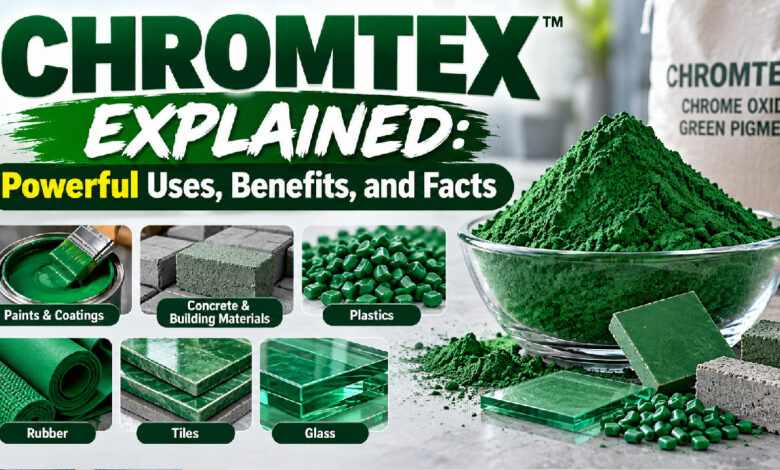
Chromtex can be confusing because the name appears in different industrial and textile-related contexts. Some online sources describe it as a textile technology, while stronger commercial documentation identifies CHROMTEX™ as a range of synthetic chrome oxide green pigments. Understanding this difference is important before discussing its uses or properties.
The documented CHROMTEX™ pigment range is associated with ZWUKSO, a Polish manufacturer of inorganic pigments. These green pigments are designed for industrial materials such as paints, concrete, plastics, rubber, tiles, flooring, enamel frits, and colored glass. Different grades are available for different manufacturing requirements.
This article explains what Chromtex is, what it is made from, how it works, its important properties, available grades, and major industrial applications. It also covers its textile connection, the difference between Chromtex and Chromatex Chemicals, safety considerations, environmental questions, pricing, packaging, and product selection.
What Is Chromtex?
Chromtex is best understood in its strongest documented commercial meaning as CHROMTEX™, a family of synthetic chrome oxide green pigments. These pigments are industrial coloring materials rather than finished fabrics, consumer products, or a single textile-processing technology. They are added to other materials to create a controlled green color.
A pigment works differently from a typical dye. Dye generally dissolves or becomes distributed at a molecular level in a suitable material, while pigment consists of small solid particles dispersed through another substance. This makes particle size, concentration, mixing, and dispersion important to the finished appearance.
CHROMTEX™ can be incorporated into paints, plastics, concrete, rubber, tiles, glass, and other manufactured products. However, the word Chromtex has appeared in other contexts as well. Readers should therefore identify the exact manufacturer and product before assuming that every reference to Chromtex means the same thing.
Who Makes CHROMTEX™?
The documented CHROMTEX™ pigment family is manufactured by ZWUKSO, a company based in Poland that specializes in inorganic pigments. The company has operated for decades and supplies pigments for different industrial applications. CHROMTEX™ is one of the product ranges connected with its industrial color portfolio.
ZWUKSO provides several CHROMTEX™ grades instead of presenting the name as one universal pigment. This is important because manufacturers may have different requirements depending on whether they are producing paint, concrete, plastic, rubber, tiles, glass, or another colored material.
Identifying the manufacturer also helps separate reliable product information from broad online descriptions. Technical products should be researched through their exact product names, grades, Technical Data Sheets, and Safety Data Sheets. This approach provides more dependable information than assuming that every website using the word Chromtex is discussing the ZWUKSO pigment range.
What Is CHROMTEX™ Made From?
CHROMTEX™ pigments are based on chromium(III) oxide, commonly written with the chemical formula Cr₂O₃. It is an inorganic chromium compound known for its characteristic green appearance. This chemical basis explains why CHROMTEX™ belongs to the chrome oxide green pigment category rather than being classified as a normal textile material.
Chromium(III) oxide is used as a solid pigment. Its particles are incorporated into another material to provide color. In practical manufacturing, however, chemical identity alone does not determine performance. Particle characteristics, concentration, dispersion, surrounding ingredients, processing conditions, and the material being colored can all influence the result.
It is also important not to treat all chromium compounds as identical. Different chemical forms and oxidation states of chromium can have different properties and safety considerations. Industrial users should therefore work with information for the exact CHROMTEX™ grade rather than applying general statements about chromium to every product.
How Does Chromtex Work as a Pigment?
CHROMTEX™ normally works as an ingredient inside a larger material system. It is not generally the final product purchased by ordinary consumers. A manufacturer introduces the pigment into another material, mixes it correctly, and processes the formulation until the desired green color is distributed throughout the finished product.
In paint, for example, pigment particles are dispersed through a coating formulation. In plastic production, they can be incorporated into a polymer system. Concrete manufacturers can mix pigment into cement-based materials, while glass, rubber, flooring, and ceramic-related industries use suitable pigment grades according to their particular production processes.
Correct dispersion is essential. Poorly distributed pigment can produce uneven shades, visible particles, streaking, or inconsistent batches. The amount of pigment also affects the final color. Manufacturers therefore normally test a pigment within the actual formulation instead of judging its performance only by looking at the dry green powder.
Main Properties of CHROMTEX™
CHROMTEX™ is mainly intended to provide green coloration to industrial materials. Manufacturer information describes the pigment as finely milled and highlights characteristics such as coloring power, hiding power, and dispersibility. These properties influence how effectively a pigment performs after it is incorporated into another material.
Coloring power describes how effectively a pigment contributes color to a formulation. Hiding power relates to its ability to reduce the visibility of the underlying surface or material. Dispersibility describes how successfully the particles can be distributed throughout the host material without creating unwanted clusters or uneven areas.
These properties should not be viewed independently. The final result can change according to pigment concentration, binder, polymer, cement mixture, manufacturing temperature, surface characteristics, and other ingredients. A property reported for one CHROMTEX™ grade should also not automatically be assumed to apply equally to every other grade in the range.
CHROMTEX™ Grades
CHROMTEX™ is a product family rather than one single pigment specification. Documented grades include CHROMTEX GA-U, GA-R, GN, GA, GA-3, GA-6, GA-40, and GA-60. The existence of these different product codes allows industrial buyers to identify a particular material instead of ordering only by the general CHROMTEX™ name.
Different industrial processes can place very different demands on pigments. Concrete has different formulation conditions from plastic, while glass manufacturing differs from paint or rubber production. This is why selecting a product simply because it belongs to the CHROMTEX™ family is not enough for professional manufacturing.
The exact Technical Data Sheet for the selected grade should be checked before use. A product code confirms that a particular variant exists, but it does not by itself establish every technical characteristic. Buyers should avoid inventing differences between grades when detailed manufacturer specifications are not available.
CHROMTEX GA-3: Technical Example
CHROMTEX GA-3 provides a useful example of how individual grades can have their own technical information. Reported information identifies chromium oxide as its main material, with a minimum Cr₂O₃ content of about 90 percent. Other reported characteristics include a pH range of 4–8 and limited water-soluble substances.
Reported GA-3 information also gives a bulk density range of approximately 800–1,300 kg/m³ and identifies the pigment with Color Index Green 17. For concrete applications, some distributor information suggests a pigment amount around 3–6 percent of cement weight, depending on the desired result and formulation.
These figures should be treated as grade-specific information rather than universal CHROMTEX™ specifications. Industrial users should confirm current values from the applicable technical documentation before production. Formulations, recommended loading levels, and processing requirements can differ, making current manufacturer information more useful than generalized online specifications.
Where Is Chromtex Used?
CHROMTEX™ has applications across several manufacturing sectors because green pigmentation is required in many different materials. Documented uses include paints, primers, fillers, facade mixtures, plastics, concrete roofing, colored bricks, tiles, rubber products, flooring, enamel frits, and colored glass.
Its function remains broadly similar across these applications: providing controlled green coloration. The way the pigment is incorporated, however, can be very different. A paint manufacturer disperses pigment through a coating system, while a concrete producer introduces it into a cementitious mixture and a plastic producer works with polymer-processing conditions.
This wide application range does not mean every CHROMTEX™ grade is suitable for every process. Temperature, chemical environment, desired shade, concentration, compatibility, and mixing method can influence grade selection. Manufacturers should match the exact pigment grade with the material and production conditions they intend to use.
Chromtex in Paints and Coatings
Paints and coatings are important applications for CHROMTEX™. The pigment can be used in paints, primers, fillers, ground paints, and facade-related formulations. In these products, pigment selection affects not only the visible shade but also how consistently that shade appears across the coated surface.
Proper dispersion is especially important. Pigment particles that are not distributed evenly can create streaks, spots, or visible differences in color. Manufacturers therefore use controlled mixing and formulation methods to distribute the pigment through the binder and other ingredients before applying the finished coating.
The appearance of a coating also depends on pigment loading, binder chemistry, surface condition, film thickness, and other pigments or additives. Consequently, manufacturers generally perform formulation trials before large-scale production. The appearance of dry CHROMTEX™ powder alone cannot reliably predict how a finished painted surface will look.
Chromtex in Concrete and Building Materials
Construction materials represent another important application area. CHROMTEX™ is documented for products such as colored concrete roofing, bricks, tiles, and facade mixtures. Instead of simply painting a finished surface green, pigment can be incorporated into the building material during production to create color within the material itself.
Consistency matters greatly in construction. Small differences between batches may become highly visible when many bricks, tiles, roofing pieces, or concrete components are installed beside one another. Controlled pigment measurement, mixing time, raw materials, water content, and production conditions can all influence the final shade.
Some GA-3 information suggests a concrete dosage of roughly 3–6 percent based on cement weight. This should be viewed as a product-specific example, not a universal formula. Manufacturers need to verify the selected grade and perform trials because different cement systems and production methods can produce different results.
Chromtex in Plastics and Rubber
CHROMTEX™ is also documented for use in plastics and rubber. In plastic manufacturing, pigments may be incorporated into polymer formulations before the material is shaped into a finished product. The pigment must disperse effectively and remain suitable for the processing conditions used with the particular plastic.
Temperature is an important consideration because many plastics are processed using heat. The polymer type, additives, pigment concentration, mixing equipment, and manufacturing temperature can influence the final appearance. Repeatability is especially valuable because industrial producers need later production batches to closely match earlier ones.
Rubber manufacturing has similar requirements for careful formulation. Rubber compounds can contain polymers, fillers, processing aids, and other additives that affect pigment behavior. Manufacturers therefore need to evaluate compatibility rather than assuming a pigment that performs well in one material will automatically produce identical results in another.
Chromtex in Glass, Tiles, and Enamel
CHROMTEX™ is also associated with colored glass, tiles, and enamel frits. These applications are technically different from ordinary paints because production can involve elevated temperatures and specialized chemical environments. Pigment selection must therefore consider more than simply the desired green shade.
Enamel frits are glass-like materials used in enamel and related surface processes. A pigment intended for these applications needs to work within the particular manufacturing conditions. Similarly, glass coloration involves processing requirements that differ substantially from mixing pigment into concrete or room-temperature coating formulations.
The fact that CHROMTEX™ is listed for glass, tile, or enamel-related applications should not be interpreted to mean that every grade is suitable for every process. Manufacturers should verify the exact grade, temperature requirements, chemical compatibility, and technical recommendations before incorporating the pigment into production.
Chromtex and the Textile Connection
The Chromtex name has a genuine textile connection, which helps explain some of the confusion surrounding it. An older Flemish research reference from 2011 describes a CHROMTEX project focused on implementing thermo- and photosensoric functionalities in textile materials, involving yarns and narrow fabrics.
In simple terms, this research concerned textile materials capable of responding to conditions such as temperature or light. However, the existence of this project does not establish that it later became the modern CHROMTEX™ pigment range manufactured by ZWUKSO. They should be treated as separate uses of a similar name unless reliable evidence establishes a direct relationship.
This distinction is particularly important for online research. Describing modern CHROMTEX™ broadly as a smart textile technology can mislead readers. The strongest current commercial documentation discussed here identifies CHROMTEX™ as a chrome oxide green pigment family rather than a fabric or universal textile-processing system.
Chromtex vs. Chromatex Chemicals
Chromtex and Chromatex Chemicals may look almost identical when written quickly, but they refer to different subjects. CHROMTEX™ is documented as an industrial chrome oxide green pigment range connected with ZWUKSO. Chromatex Chemicals Pvt. Ltd., by contrast, is a separate company operating in Pakistan’s textile chemical industry.
Chromatex Chemicals supplies auxiliary chemicals used in textile pretreatment, dyeing, and finishing. Its product categories include materials such as enzymes, antifoams, wetting agents, detergents, leveling agents, fixing agents, softeners, binders, and stabilizers. These products have a different purpose from the CHROMTEX™ green pigment range.
The additional letter “a” therefore matters. Information about Chromatex Chemicals should not automatically be used to explain CHROMTEX™, and information about ZWUKSO pigments should not be presented as the history of Chromatex Chemicals. Checking spelling and manufacturer identity prevents this common research error.
Why Is There Conflicting Information About Chromtex?
Conflicting information exists partly because the name Chromtex sounds closely connected with textiles. The “tex” ending can easily make readers assume it refers to fabric or textile processing. Similar commercial names, historical projects, and loosely written online articles make the search results even more difficult to interpret.
Some pages may describe Chromtex as an advanced textile system, fabric treatment, sustainable material, company, or general manufacturing technology. Such descriptions require verification. Without a confirmed manufacturer, product documentation, company history, technical specification, or credible research source, broad claims should not automatically be treated as established facts.
A better research method begins with exact identification. Readers should check the spelling, manufacturer, product category, chemistry, intended application, and technical documents. In the strongest current commercial documentation, this process leads to CHROMTEX™ from ZWUKSO and its identity as a chrome oxide green industrial pigment range.
Is Chromtex Safe?
There is no useful one-word answer to whether Chromtex is safe because industrial safety depends on the exact substance, grade, exposure conditions, and method of use. CHROMTEX™ is associated with chromium(III) oxide, but this should not be confused with the assumption that all chromium-containing compounds have identical properties or hazards.
Industrial users should consult the current Safety Data Sheet for the exact CHROMTEX™ grade. An SDS provides information about handling, storage, exposure controls, protective equipment, accidental release procedures, and emergency measures. This documentation is more appropriate for workplace decisions than a general description found in an online article.
Good industrial practice may include controlling airborne dust, maintaining suitable ventilation, avoiding unnecessary skin or eye exposure, following hygiene procedures, and using appropriate protective equipment where specified. Workers and manufacturers should always follow current supplier documentation and applicable workplace regulations for the actual product being handled.
Environmental and Sustainability Considerations
Environmental discussions about Chromtex need the same level of precision as safety discussions. The word “green” describes the pigment’s color and should not automatically be interpreted as meaning environmentally friendly. A reliable sustainability assessment requires information about the actual product, manufacturing process, supply chain, use, and disposal.
Environmental performance can involve raw materials, manufacturing energy, emissions, packaging, transportation, waste, workplace practices, product durability, and end-of-life management. A durable pigment may potentially contribute to longer-lasting colored products, but such benefits should be supported by actual performance information rather than assumed from the pigment name.
Chromium chemistry also requires careful terminology because different chromium compounds have different characteristics. Broad historical concerns about certain chromium compounds should not automatically be assigned to every chromium-based material. Buyers seeking sustainable products should look for current environmental documentation, certifications where applicable, and verifiable manufacturer information instead of relying on marketing language.
Packaging, Availability, and Pricing
CHROMTEX™ is primarily an industrial material, so its packaging is designed mainly for commercial manufacturing rather than ordinary household use. Documented packaging for the product range includes 25-kilogram bags and large 1,000-kilogram big-bags, although buyers should confirm packaging for the exact grade they require.
Availability may vary according to country, supplier, grade, order quantity, and current stock. Some distributors may offer smaller amounts, while large manufacturers may purchase bulk quantities. Buyers should also verify whether a seller is providing the exact CHROMTEX™ grade instead of a similarly named pigment or unrelated material.
There is no single universal price for Chromtex. Cost can depend on grade, quantity, packaging, supplier terms, destination, transportation, and market conditions. For meaningful price comparisons, industrial buyers should request quotations for the same grade, quantity, specification, and delivery conditions rather than comparing unrelated online listings.
How to Choose the Right CHROMTEX™ Grade
Choosing a CHROMTEX™ grade should begin with the final material and production process. A manufacturer making colored concrete has different requirements from a business producing plastic components, coatings, rubber products, tiles, or glass. The product name alone cannot determine whether a particular grade is suitable.
The next step is reviewing current technical documentation. Buyers should confirm the manufacturer, exact grade, intended applications, Technical Data Sheet, Safety Data Sheet, recommended pigment loading where provided, processing conditions, compatibility, storage instructions, packaging, and any regulatory documentation required for their market.
Testing is also important before full production. A laboratory sample can show whether the pigment provides the required color and dispersion, while a production trial can reveal issues related to equipment, temperature, mixing, or batch consistency. The most reliable choice is therefore based on documented specifications and real application testing rather than general product descriptions.
Conclusion
Chromtex is easier to understand once its different uses are separated. The strongest documented current commercial meaning is CHROMTEX™, a synthetic chrome oxide green pigment family associated with ZWUKSO. It is based on chromium(III) oxide and is intended for coloring a variety of industrial materials.
Its documented applications include paints, coatings, plastics, concrete products, bricks, tiles, rubber, flooring, enamel frits, and colored glass. Multiple CHROMTEX™ grades exist, which means industrial users need to select products according to their actual manufacturing process instead of assuming every grade performs identically.
The name can still cause confusion because of an older textile research project and the separate company Chromatex Chemicals. For accurate research or purchasing, the best approach is to verify the spelling, manufacturer, exact grade, intended application, Technical Data Sheet, and Safety Data Sheet before drawing conclusions about Chromtex.
Frequently Asked Questions
What is Chromtex?
Chromtex most commonly refers to CHROMTEX™, a range of synthetic chrome oxide green pigments. These industrial pigments are based on chromium(III) oxide and are used to add green color to materials such as paints, concrete, plastics, rubber, tiles, and glass.
What is CHROMTEX™ made from?
CHROMTEX™ pigments are based on chromium(III) oxide, which has the chemical formula Cr₂O₃. It is an inorganic green pigment. The exact composition and technical properties can vary between CHROMTEX™ grades, so users should check the relevant Technical Data Sheet.
What is Chromtex used for?
Chromtex is used mainly for industrial coloring applications. Documented uses include paints and coatings, plastics, concrete roofing, colored bricks, tiles, rubber products, flooring, facade mixtures, enamel frits, and colored glass. The correct grade depends on the material and manufacturing process.
Is Chromtex a textile product?
CHROMTEX™ is not primarily documented as a textile product. Its strongest current commercial meaning is a chrome oxide green pigment range. However, the Chromtex name has also appeared in an older textile research project, which can cause confusion in online search results.
What is the difference between Chromtex and Chromatex?
CHROMTEX™ and Chromatex Chemicals are different. CHROMTEX™ is a chrome oxide green pigment range associated with ZWUKSO. Chromatex Chemicals Pvt. Ltd. is a separate Pakistani company that produces auxiliary chemicals for textile pretreatment, dyeing, and finishing.