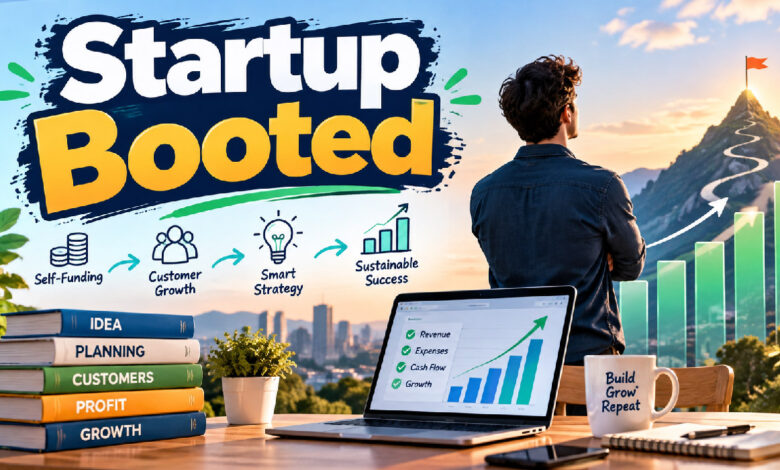
Starting a business does not always require venture capital or a large investment. The startup booted approach focuses on starting with available resources, finding real customers, controlling expenses, and using business revenue to support future growth.
For many founders, this method provides a practical way to test an idea without giving away ownership too early. Instead of spending heavily before demand exists, founders learn from customers, improve the product, and invest where results can be measured.
However, bootstrapping is not simply about spending less money. Successful founders must understand cash flow, pricing, customer acquisition, profitability, and when additional capital could accelerate a proven opportunity. This guide explains how the approach works from idea to sustainable growth.
What Does Startup Booted Mean?
The phrase startup booted is commonly understood in the context of bootstrapping a startup. A bootstrapped business begins primarily with resources available to its founders rather than depending immediately on venture capital or other major outside investments.
Initial resources may include personal savings, existing equipment, founder skills, early customer payments, or income from another source. Once customers begin paying, the business can reinvest part of that revenue into product development, marketing, operations, and customer support.
This approach encourages founders to connect spending with actual business needs. Instead of hiring a large team or developing every planned feature immediately, they can concentrate resources on activities that help validate demand, serve customers, or generate sustainable revenue.
Being startup booted does not necessarily mean rejecting investors forever. A company can begin as a bootstrapped business and later consider equity investment, debt, grants, or other financing when additional capital has a clear strategic purpose.
How the Startup Booted Approach Works
A startup booted journey normally begins with a specific customer problem rather than an expensive product. Founders identify who experiences that problem, how serious it is, what alternatives already exist, and whether customers would pay for a better solution.
The next stage involves testing the business idea with limited resources. This may involve interviews, demonstrations, landing pages, prototypes, pre-orders, paid trials, or a minimum viable product. The objective is to collect evidence before making large financial commitments.
Once the startup attracts paying customers, revenue becomes an important source of growth capital. Money can be reinvested into areas such as product improvements, marketing, software, customer service, contractors, or employees when these investments make financial sense.
As the company develops, decisions become increasingly data-driven. Founders can compare revenue, expenses, customer retention, acquisition costs, margins, and cash flow. Stronger evidence allows the company to invest more confidently without abandoning financial discipline.
Startup Booted vs Traditional Bootstrapping
Startup Booted and bootstrapping generally describe closely related ideas. Traditional bootstrapping means building a company using founder resources and internally generated revenue instead of relying heavily on external investors during the company’s early development.
The main principle is financial independence. Founders usually keep greater ownership because they have not exchanged large equity stakes for investment. They also maintain considerable control over decisions involving products, pricing, hiring, customers, and long-term business direction.
In practical use, startup booted can also describe a more flexible approach. A founder might bootstrap the early business, prove demand, establish revenue, and then accept carefully selected financing when capital can accelerate something that has already demonstrated potential.
Therefore, founders should focus less on terminology and more on financial strategy. The important questions are whether customers genuinely value the product, whether the company can manage its expenses, and whether additional capital would produce worthwhile business results.
Startup Booted vs Venture-Funded Startups
A venture-funded startup receives investment from external investors who generally expect ownership and significant future growth in return. This capital can allow businesses to recruit employees, develop technology, market products, and expand faster than their existing revenue permits.
A startup booted company normally faces tighter financial limits. Hiring and expansion may happen more slowly because spending must remain connected to available cash. This limitation can encourage founders to prioritize projects that directly improve products, customer satisfaction, or revenue.
The trade-off is ownership and control. Bootstrapped founders may retain more equity and greater flexibility over their company’s direction. Venture-backed founders gain access to capital and potentially useful investor networks but also accept expectations associated with outside ownership.
Neither model automatically produces a better company. Some opportunities require substantial upfront investment, while software, consulting, digital products, and certain service businesses can sometimes start relatively cheaply. The appropriate funding model depends on economics, market conditions, and growth requirements.
Start With a Real Customer Problem
Strong businesses generally solve problems that customers actually care about. Before developing an expensive solution, founders should understand the target customer, the problem being experienced, its frequency, existing alternatives, and the consequences of leaving it unresolved.
Customer interviews can provide useful information, but founders should distinguish interest from purchasing intent. People frequently describe ideas as useful without eventually buying them. Actual purchases, deposits, subscriptions, contracts, and paid trials usually provide stronger evidence of commercial demand.
Competitor research is equally useful. Existing competitors can demonstrate that demand already exists while revealing weaknesses in current solutions. Founders can examine pricing, positioning, customer complaints, product limitations, distribution methods, and underserved groups to identify possible opportunities.
This research reduces unnecessary spending. Instead of building based entirely on assumptions, a startup booted founder can make smaller experiments, collect evidence, and change direction early. Learning cheaply is often more valuable than building an impressive product nobody wants.
Build an MVP Without Overspending
A Minimum Viable Product, commonly called an MVP, is the simplest practical version of a solution that allows founders to test important assumptions with real users. It should provide enough value to generate meaningful customer feedback.
An MVP does not necessarily need sophisticated software. A founder might initially deliver part of a service manually, use existing tools, build a simple website, create a prototype, or combine several inexpensive platforms before investing in custom technology.
Cost reduction should never mean ignoring essential standards. Privacy, cybersecurity, customer safety, product reliability, contractual obligations, and regulatory requirements may still matter at the MVP stage. Cutting costs in critical areas can create much larger problems later.
Feedback from early customers should guide improvements. Founders can identify which features people regularly use, what confuses, why customers purchase, and what prevents others from buying. Development resources can then focus on improvements supported by actual customer behavior.
Find the First Paying Customers
Early customers provide more than revenue. They help determine whether the startup has created something people genuinely value. Even a small number of paying customers can generate useful information about positioning, pricing, product quality, and purchasing decisions.
Founders frequently handle early sales themselves because direct conversations produce valuable insights. They hear customer objections, questions, priorities, and complaints without those details being filtered through a larger sales organization. This knowledge can influence both marketing and product development.
Customer acquisition methods depend on the market. Options can include targeted outreach, referrals, partnerships, professional communities, search-focused content, product demonstrations, social platforms, marketplaces, industry events, or carefully controlled advertising experiments rather than expensive campaigns launched without evidence.
The objective is eventually to identify a repeatable acquisition process. Founders should learn where valuable customers come from, what messages encourage action, how much acquisition costs, and whether those customers remain profitable after delivery and support expenses.
Create a Practical Startup Budget
A startup booted business needs a clear budget because financial mistakes can quickly reduce its options. Founders should identify recurring expenses such as software, hosting, payroll, contractors, insurance, marketing, professional services, equipment, rent, and necessary administrative costs.
Expenses can be separated into fixed and variable categories. Fixed costs remain relatively stable despite changes in sales, while variable costs generally increase with business activity. Understanding this difference helps founders estimate how growth will affect the company’s overall cost structure.
One-time expenses also deserve attention. Business registration, equipment, professional advice, product development, branding, deposits, and initial setup costs can create significant cash requirements even though they do not appear every month. Ignoring them can make projections misleading.
A lean budget should not automatically choose the cheapest option. The objective is efficient allocation. Spending more can be sensible when an investment improves reliability, saves substantial time, protects the company, increases profitable sales, or removes an important growth constraint.
Understand Cash Flow, Burn Rate, and Runway
Profit and cash flow are related but different. A business can record sales while still experiencing cash pressure because payments arrive later than expenses. Startup booted founders therefore need to understand when money actually enters and leaves their accounts.
Burn rate measures how quickly available cash is being consumed when cash outflows exceed inflows. Monitoring this figure helps founders understand whether current spending is sustainable and whether costs need adjustment before the business reaches a serious financial problem.
Runway estimates how long available cash can support the business under its current financial conditions. A simple estimate divides available cash by monthly net cash burn, although real forecasts should consider changing revenue, costs, payment timing, and upcoming one-time expenses.
Founders should regularly update their cash forecasts instead of relying on an old spreadsheet. New customers, lost customers, hiring, price changes, unexpected bills, delayed payments, and changing marketing performance can quickly make previous assumptions inaccurate.
Track the Metrics That Actually Matter
Revenue is important, but revenue alone cannot explain whether a startup is healthy. Founders should combine financial measures with customer and operational data to understand whether growth is sustainable and whether the underlying business model is improving.
Customer Acquisition Cost, or CAC, measures the cost associated with acquiring customers. Customer Lifetime Value, often shortened to LTV, estimates the economic value generated by customers over their relationship with the business. Both calculations require careful definitions to remain useful.
Subscription businesses often monitor Monthly Recurring Revenue, retention, churn, gross margin, and sometimes Net Revenue Retention. Other business models may focus more heavily on repeat purchases, contribution margin, average order value, inventory turnover, utilization, or customer concentration.
Metrics should support decisions rather than become vanity numbers. A large number of website visitors or registered users may look impressive but offer little value if visitors never purchase. Startup booted founders should prioritize measurements connected to customers, cash, and sustainable economics.
Use Revenue to Support Sustainable Growth
Revenue-funded growth means using money generated by customers to strengthen the company. Instead of spending far ahead of demand, founders can increase investment as the business demonstrates that customers will consistently pay for its products or services.
Reinvestment priorities should depend on current bottlenecks. If demand exists but product reliability is poor, engineering may deserve investment. If retention is strong but few customers discover the product, marketing or sales may offer a more valuable opportunity.
Hiring should follow similar logic. Adding employees creates recurring expenses that can become difficult to reverse. Before hiring, founders should identify the work required, expected business impact, available cash, and whether automation or contractors could provide a lower-risk temporary solution.
Sustainable growth is not necessarily slow growth. A profitable company with strong customer demand can expand rapidly. The difference is that growth is supported by evidence and economics rather than being based primarily on assumptions about future investment.
Know When Your Startup Is Ready to Scale
Scaling means increasing business activity without allowing costs and operational problems to grow uncontrollably. Before scaling, founders should have reasonable evidence that customers want the product and that the company can repeatedly acquire and serve those customers.
Useful signs include recurring or repeat sales, healthy customer retention, manageable acquisition costs, stable product performance, positive customer feedback, improving margins, and a sales process that produces reasonably predictable outcomes. Not every signal must be perfect before expansion.
Founders should also identify the constraint preventing further growth. The problem could be insufficient leads, production capacity, onboarding, technology, customer support, inventory, geographic limitations, or staffing. Investment becomes more effective when it targets a clearly identified bottleneck.
Scaling an unproven model can multiply losses instead of success. If acquiring every new customer loses significant money, spending heavily to acquire thousands more customers makes the financial problem larger. Founders should strengthen basic economics before aggressively increasing volume.
Benefits of the Startup Booted Model
Founder control is one of the most attractive benefits. Without major outside shareholders during the early stages, founders can often make product, pricing, hiring, and strategic decisions according to business needs rather than an investor’s preferred growth schedule.
Ownership is another advantage. Equity given away during early fundraising cannot simply be recovered later. Founders who build substantial value before seeking investment may retain a larger percentage of their companies or negotiate from a stronger position if they eventually raise capital.
Financial limitations can also create discipline. When resources are scarce, teams must prioritize carefully. Features, subscriptions, marketing campaigns, and hires face greater scrutiny because every expense competes with other important needs for a limited amount of cash.
Most importantly, bootstrapping can keep attention on customers. Investment is evidence that investors see potential, but it does not prove customer demand. Revenue demonstrates that at least some customers are willing to exchange money for the value the business provides.
Challenges of Building Without Major Funding
Limited capital can slow development and expansion. A founder may identify a valuable opportunity but lack enough cash to hire specialists, purchase inventory, develop technology, increase production, or enter a market before a better-funded competitor moves aggressively.
Bootstrapping can also increase personal financial exposure. Founders using their savings need clear limits on how much personal capital they are prepared to risk. Continuing to inject money into an unvalidated business can turn commercial uncertainty into serious personal financial pressure.
Small teams face workload challenges as well. Founders may simultaneously handle product development, sales, marketing, customer service, finance, and administration. Excessive workloads can reduce decision quality and make it difficult to concentrate on the activities with the highest value.
Another danger is becoming excessively frugal. Refusing to spend can be just as damaging as overspending. Cybersecurity, accounting, legal compliance, reliable infrastructure, important employees, and effective distribution may require real investment for the business to develop safely.
Common Startup Booted Mistakes
Building too much before customer validation is a common mistake. Months can be spent developing sophisticated features before founders discover that customers wanted something simpler or had no willingness to pay. Small experiments can expose these problems much earlier.
Premature hiring is another risk. Employees create recurring financial commitments, while expensive offices, unnecessary subscriptions, and long contracts increase fixed costs. Founders should understand the expected return and available runway before significantly increasing permanent monthly expenses.
Underpricing can also damage a bootstrapped company. Low prices may attract buyers while leaving too little gross profit to pay for customer support, product development, marketing, taxes, and overhead. Pricing needs to reflect both customer value and sustainable business economics.
Finally, founders can become emotionally attached to their original plans. Evidence may show that positioning, pricing, target customers, or features need to change. Bootstrapping works best when limited resources encourage faster learning rather than forcing founders to defend outdated assumptions.
When Bootstrapping May Not Be Enough
Not every company is suitable for a heavily bootstrapped beginning. Some business models require significant investment before meaningful revenue becomes possible. The amount and timing of required capital therefore matter when founders choose an appropriate financing strategy.
Hardware and manufacturing businesses may need prototypes, tooling, inventory, facilities, certifications, and supply-chain commitments. Biotechnology and certain medical businesses can face expensive research, clinical, regulatory, and specialized staffing requirements before they can commercially launch products.
Some technology companies also operate in markets where speed matters greatly. If building infrastructure or entering multiple markets quickly creates a meaningful competitive advantage, waiting for customer revenue to finance every stage could allow well-capitalized competitors to establish stronger positions.
In such situations, external financing is not evidence of poor financial discipline. Capital is a business tool. The important question is whether funding creates more value than its financial cost, ownership dilution, repayment obligations, and other conditions attached to it.
When a Startup Should Consider Outside Funding
A startup should consider external capital when founders can explain exactly what the money will accomplish. Raising funds simply because other startups do it is weak reasoning. Capital should solve a specific constraint or capture an identifiable business opportunity.
For example, demand might exceed current production capacity, or a proven sales channel could support substantially more customers with additional spending. Funding might also finance important technology, inventory, regulatory work, market expansion, or specialized employees the company cannot currently afford.
Different funding sources create different obligations. Equity investors receive ownership, while loans normally require repayment and may involve interest, guarantees, or security. Grants, crowdfunding, strategic investment, and revenue-linked financing can have their own eligibility requirements and contractual conditions.
Before accepting money, founders should model its effect on cash flow, ownership, risk, and decision-making. Funding should ideally make a fundamentally promising business stronger rather than temporarily hiding weak demand, poor margins, or an unsustainable customer acquisition strategy.
Startup Booted Financial Planning
Financial modeling helps founders convert assumptions into numbers. A simple model can estimate revenue, expenses, cash flow, hiring requirements, and future cash balances. It does not predict the future perfectly; its value comes from showing how different assumptions affect outcomes.
Revenue forecasts should preferably begin with measurable drivers. Founders can estimate customer numbers, pricing, purchase frequency, conversion, retention, and sales capacity rather than simply claiming a small percentage of a huge market. Bottom-up assumptions are easier to test.
Scenario planning makes the model more useful. A founder can create conservative, expected, and stronger-performance scenarios. If sales are delayed, acquisition becomes more expensive, or a major customer leaves, the model can show how quickly the company’s financial position changes.
Actual performance should then replace assumptions over time. Comparing forecasts with real results shows where the original model was wrong. Regular updates transform financial planning from a fundraising exercise into an operational tool for managing a startup booted business.
Tools That Can Help a Bootstrapped Startup
A startup does not need an expensive technology stack from its first day. Spreadsheets can handle early budgets, forecasts, pricing models, customer lists, and basic performance tracking. More specialized software can be introduced when complexity genuinely requires it.
Cloud services, automation platforms, accounting applications, customer relationship management systems, project tools, and no-code products can reduce the need to build everything internally. Founders should still evaluate security, reliability, data portability, integrations, and long-term pricing before becoming dependent on a tool.
AI assistants can also support research, brainstorming, formula creation, documentation, data interpretation, customer-support drafts, and repetitive administrative work. Their output still needs human review, especially for financial, legal, security, tax, or other high-stakes business decisions.
The correct tool solves a real problem at an acceptable cost. Buying software because it is popular creates unnecessary overhead. A startup-booted team should periodically review subscriptions and remove tools that no longer provide measurable value.
Is Startup Booted Right for Every Founder?
Startup Booted works particularly well when a business can reach customers without enormous upfront investment. Service companies, consultancies, software products, agencies, digital businesses, and some online businesses may be able to validate demand with relatively limited initial resources.
The approach is less suitable when substantial capital is structurally required before customers can be served. Founders should estimate development costs, regulatory requirements, inventory needs, time to market, competition, and expected time before revenue before deciding how heavily to bootstrap.
Personal circumstances also matter. Founders have different savings, responsibilities, risk tolerance, expertise, and access to resources. A financing strategy that works comfortably for one entrepreneur may create unacceptable financial pressure for another founder with a different situation.
The objective should therefore not be to prove that bootstrapping is superior to investment. The objective is to select a financing strategy that fits the business while protecting its ability to serve customers, manage risk, and create sustainable long-term value.
Final Thoughts
The startup booted approach is ultimately about building with financial discipline. Founders begin with the resources they can reasonably access, validate customer demand, create a focused product, monitor cash carefully, and reinvest revenue where it can produce meaningful results.
Its greatest advantage is not simply avoiding investors. The model forces founders to understand the fundamentals of their businesses. Pricing, margins, acquisition, retention, cash flow, customer satisfaction, and operating costs become essential because there is less capital available to hide weak economics.
At the same time, bootstrapping should never become a rule against spending or funding. Good founders invest when evidence supports investment. They can also raise outside capital when doing so provides a sensible way to overcome a constraint or capture a proven opportunity.
A strong startup is not defined by where its money comes from. It is defined by whether it solves a valuable problem, earns customer trust, manages resources intelligently, and develops economics that can support the business over the long term.
(FAQs)
What does startup booted mean?
Startup booted generally describes building a startup mainly with founder resources and money generated from customers. The business controls expenses carefully, tests customer demand early, and reinvests revenue to support continued development and growth.
Is startup booted the same as bootstrapping?
The terms are closely related. Bootstrapping means developing a business primarily through founder resources and internally generated revenue. A bootstrapped company can still decide to use loans, investors, grants, or other financing later.
Can a bootstrapped startup become successful?
Yes. Bootstrapping does not prevent a business from growing successfully. Results depend on factors such as customer demand, pricing, product quality, margins, cash management, competition, execution, and the company’s ability to acquire and retain profitable customers.
How much money is needed to bootstrap a startup?
There is no universal amount. Required capital depends on the business model, product-development costs, employees, equipment, inventory, marketing, regulation, and time required to generate revenue. Some businesses can start much more cheaply than others.
What are the main benefits of startup booted growth?
Important benefits can include greater founder ownership, more strategic control, careful spending, and stronger attention to paying customers. Founders may also gain time to validate their business model before accepting the obligations associated with outside capital.
What is the biggest risk of bootstrapping a startup?
Running out of cash is a major risk. Limited resources can also restrict hiring, marketing, development, and expansion. Founders should monitor cash flow, expenses, customer demand, margins, and runway instead of concentrating only on revenue growth.
When should a bootstrapped startup seek funding?
Funding may make sense when capital can address a clearly identified constraint or accelerate a proven opportunity. Examples include increasing production, hiring essential specialists, expanding successful distribution, entering new markets, or completing necessary infrastructure or regulatory work.
What metrics should a startup booted business track?
Useful metrics can include revenue, cash flow, gross margin, acquisition cost, retention, churn, and runway. Subscription companies may also monitor MRR, ARR, and Net Revenue Retention. The most useful metrics depend on the startup’s business model.