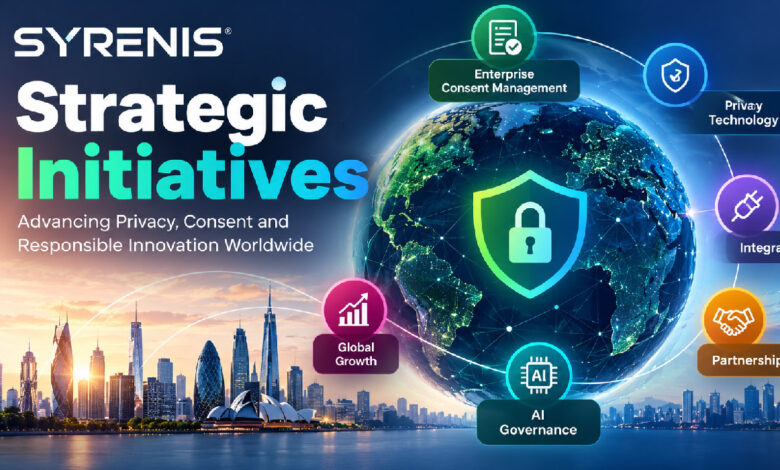
Syrenis strategic initiatives show how modern privacy technology is moving beyond simple consent banners toward connected enterprise data management. Syrenis focuses on helping large organizations capture customer choices, manage preferences, connect privacy information with business systems, and maintain reliable records across different channels.
The company’s direction matters because customer data rarely stays inside one website or application. It moves through CRM platforms, marketing tools, mobile apps, analytics systems, customer service software, and internal databases. Privacy choices therefore need to travel with that data accurately.
Syrenis is also developing its position through international expansion, enterprise integrations, strategic partnerships, privacy governance, and a stronger presence in the United States. These areas support its broader goal of making privacy information useful throughout complex organizations rather than keeping it isolated.
This article explains Syrenis strategic initiatives in easy English, including consent and preference management, system connectivity, enterprise growth, customer experience, partnerships, regulatory challenges, and AI governance. It also examines the practical benefits and limitations organizations should consider when evaluating this approach.
Understanding Syrenis Strategic Initiatives
Syrenis strategic initiatives can be understood as the connected business and technology priorities supporting the company’s enterprise privacy direction. The phrase is not the official name of one product. Instead, it describes areas such as platform development, integrations, partnerships, governance, and international growth.
At the center of this strategy is a common enterprise problem: customer privacy decisions can become scattered across many systems. Someone might change a marketing preference through one channel while another database continues using an older choice, creating inconsistency and possible compliance problems.
Syrenis aims to reduce these gaps by providing a central environment for managing consent and preference information. Customer decisions can be linked with identities and shared with connected systems, allowing different business teams to work from more consistent and current privacy information.
This approach makes privacy an operational data issue as well as a compliance issue. Legal teams need evidence, marketers need accurate communication preferences, technology teams need reliable integrations, and customers need understandable controls. Syrenis attempts to connect these requirements through one enterprise platform.
Why Enterprise Privacy Needs Connected Data
Modern companies can interact with one customer through websites, mobile applications, physical stores, email, support centers, membership accounts, and advertising systems. Each interaction may create or change information about what the customer allows, refuses, prefers, or wants to receive.
Problems appear when each channel stores decisions separately. An email system might record an unsubscribe while a CRM still lists the customer as available for marketing. Unless these systems communicate properly, outdated information can continue influencing automated workflows and customer communications.
Enterprise consent management addresses this problem by treating privacy decisions as data that must move between systems. A new decision should be recorded, connected with the correct identity, and made available to applications that need to follow it within the organization.
For Syrenis, this connected model is central to its strategic direction. It changes consent from a static record into operational information. The goal is not simply proving that someone clicked a button but helping the organization consistently apply that decision afterward.
Building a Trusted Consent Record
A major part of the Syrenis approach is maintaining a reliable source of consent and preference information. Instead of allowing departments to depend entirely on separate records, an organization can establish a central view showing the choices associated with a particular customer.
Such records are useful because consent can change. Someone may initially agree to marketing, later restrict certain communications, and eventually withdraw permission. A useful enterprise system therefore needs history rather than only displaying the customer’s latest yes-or-no status.
Time-stamped records can support audits and internal reviews by showing when decisions were captured and how they changed. They can also help privacy teams investigate problems when two connected applications contain conflicting information about the same person or permission.
Centralization does not automatically make an organization compliant. Legal requirements, security practices, data policies, and correct system configuration remain necessary. However, a dependable consent history can provide better evidence and make privacy decisions easier to understand across large and complicated technology environments.
Consent and Preferences Serve Different Purposes
Consent and customer preferences are closely connected, but they should not be treated as identical information. Consent generally deals with whether an organization has permission for an activity, while preferences describe how a person would like an allowed relationship or communication to work.
For example, a customer might permit marketing communication but prefer email instead of text messages. Another person may want product updates but not general promotional offers. Capturing these details gives companies more information than a simple subscribed-or-unsubscribed status can provide.
Syrenis supports preference management so organizations can give customers more detailed controls. Preference centers can provide a place where people review or change topics, communication channels, and other available choices without needing to end every type of communication.
Accurate preference information can also improve customer experience. Businesses can avoid some irrelevant outreach and better understand declared customer interests. However, improved engagement is not guaranteed by software. Results depend on data quality, implementation, communication strategy, and whether teams actually respect recorded choices.
Connecting Privacy With Enterprise Systems
Consent information becomes far more useful when it can reach the applications responsible for using customer data. Large enterprises may operate CRM platforms, marketing automation software, analytics tools, ecommerce systems, customer databases, identity services, websites, mobile applications, and support platforms simultaneously.
Syrenis places significant emphasis on integrations, APIs, connectors, data mapping, and synchronization. The company reports support for more than 350 integrations. Because integration catalogs can change, organizations should confirm current compatibility with their own systems before making an implementation decision.
This integration model can reduce the need to replace an entire technology stack. Instead, organizations can introduce a privacy and consent layer that exchanges information with existing tools. That can be particularly important for established enterprises with expensive legacy and cloud infrastructure.
Speed matters as well. If someone withdraws a permission, connected applications should receive the updated decision promptly. Effective synchronization helps prevent outdated preferences from remaining active elsewhere, turning privacy management into an ongoing process instead of a one-time data collection exercise.
Managing Privacy Across Websites and Brands
Large organizations frequently operate more than one website, digital service, or brand. Repeatedly asking the same customer for similar privacy decisions can create unnecessary friction, especially when those properties belong to the same organization and operate within an approved consent structure.
Cross-domain consent is designed to address this situation. Under an appropriately configured system, an existing choice can be recognized across approved connected domains rather than forcing the individual to repeatedly provide the same decision whenever they move between related digital properties.
This can create a smoother user experience and reduce consent fatigue. It is particularly relevant to enterprises operating multiple brands or regional websites. The underlying goal remains consistency: customer decisions should remain understandable and manageable as users move through an organization’s digital ecosystem.
Cross-domain functionality still requires careful configuration. Different websites can involve different purposes, technologies, audiences, and legal requirements. A shared technical capability does not mean every consent decision can automatically be transferred everywhere without evaluating the applicable privacy and regulatory conditions.
Supporting First-Party Data Strategies
Changes in digital privacy have made directly collected customer information increasingly important. First-party data comes from a company’s own relationship with its customers and can include declared interests, account details, communication choices, purchase activity, and information people intentionally provide.
Preference management can improve the quality of this information because customers directly communicate what they want. Instead of relying only on inferred interests, businesses can collect declared preferences while giving individuals controls over how their information and communications are handled.
Progressive profiling provides another approach. Rather than presenting customers with a large form and requesting many details immediately, organizations can collect appropriate information gradually during relevant interactions. This can reduce friction while building a more useful customer profile over time.
The important limitation is permission. Collecting first-party information does not automatically allow unlimited use of it. Organizations still need appropriate legal grounds, transparent notices, security controls, and respect for recorded choices. Better data collection must operate alongside responsible data governance.
Improving Privacy Experience for Customers
Privacy user experience, often called privacy UX, describes how easy it is for people to understand and control privacy choices. Confusing language, hidden controls, and complicated forms can make technically available options difficult for ordinary customers to use effectively.
Syrenis strategic initiatives place preference management and consent experience within the wider customer journey. Clear preference centers can allow people to review communication settings, update choices, and understand what options are available without searching through multiple pages or contacting customer support.
Better controls can benefit companies too. When customers provide accurate preferences, marketing and service teams receive clearer signals about what people actually want. This may reduce irrelevant communications and improve the usefulness of customer data when the recorded decisions are properly applied.
Trust, however, cannot be created through interface design alone. Companies must also behave consistently with the choices they collect. A well-designed preference center loses value if connected systems ignore changes or continue processing information in ways customers did not reasonably expect.
Expanding Privacy Governance Beyond Consent
Enterprise privacy includes much more than collecting permissions. Organizations must understand what personal information they process, why they process it, which policies apply, how rights requests are handled, and what evidence can be produced when their practices are reviewed.
Syrenis has broadened its platform direction toward privacy governance functions. These areas include risk assessments, processing records, policy mapping, privacy notice management, rights-request workflows, jurisdiction monitoring, case tracking, and compliance reporting alongside its established consent and preference capabilities.
This broader direction is strategically important. A company positioned only around website consent competes within a narrower technology category. A platform involved in governance, data movement, policy, preferences, and privacy operations can participate in more parts of an enterprise privacy program.
For customers, consolidation can also reduce fragmentation when implemented correctly. Privacy teams may gain better visibility across related workflows instead of moving between disconnected systems. Enterprises should still evaluate individual capabilities carefully rather than assuming one platform automatically replaces every specialist privacy or governance tool.
Growing in the United States
International expansion is another visible part of Syrenis strategic initiatives. The company reports locations in Daresbury in the United Kingdom and Austin and Atlanta in the United States, giving it a stronger base for enterprise customer relationships and partnerships in North America.
The United States presents an important privacy technology market because organizations operate under an expanding collection of state-level privacy requirements rather than one comprehensive federal framework equivalent to the European Union’s GDPR. Requirements can differ depending on jurisdiction and processing activity.
For enterprises operating nationally, regulatory fragmentation creates operational complexity. The same customer databases, websites, marketing systems, and analytics infrastructure may serve people across several states. Businesses therefore need processes capable of applying relevant rules without unnecessarily dividing customer information into isolated systems.
A stronger U.S. presence can help Syrenis work more closely with enterprises facing these challenges. It also supports commercial growth, local partnerships, implementation relationships, and feedback from organizations in data-intensive industries such as finance, healthcare, retail, technology, and media.
Using Partnerships to Support Enterprise Projects
Installing privacy software is only one part of an enterprise privacy project. Companies may also require legal interpretation, data mapping, process redesign, technical implementation, employee training, governance development, and coordination between privacy, IT, marketing, security, and data teams.
Syrenis has developed relationships with specialist consulting and privacy organizations to address this broader requirement. Its reported alliances include The Data Privacy Group and Myna, while materials involving KPMG demonstrate its interest in working with implementation and professional-services ecosystems around consent programs.
The partnership model allows different organizations to contribute specialized expertise. Syrenis can provide privacy technology while consultants support strategy, implementation, and organizational change. This can be useful for large deployments where technical configuration must align with wider privacy policies and business processes.
Partnerships still require clear responsibilities. Enterprises should understand which organization handles technical implementation, privacy advice, ongoing support, configuration, and governance. A strong partner ecosystem can extend a software platform’s reach, but unclear ownership can also create delays and accountability problems during complicated projects.
Connecting Consent Data With AI Governance
Artificial intelligence has increased attention on the origin, quality, permission status, and permitted purposes of data. Organizations using personal information in AI-related processes may need evidence showing where that information came from and what restrictions apply to its use.
Syrenis has connected consent management with this wider governance discussion. Detailed records can potentially help teams identify what permission was collected, the purpose connected with that decision, when it occurred, and whether the person subsequently changed or withdrew their choice.
This creates a useful control layer for some AI data decisions. Before information enters an AI-related workflow, organizations can evaluate relevant consent and purpose records alongside their other governance requirements. Better provenance can make internal reviews and accountability processes more defensible.
Consent records are not a complete AI governance system. Organizations still require security, access management, data-quality controls, model evaluation, risk assessments, legal analysis, human oversight, and appropriate policies. Syrenis can support the data-permission layer, but responsible AI requires a much broader framework.
Benefits and Limits for Large Enterprises
For large organizations, the strongest potential benefit of Syrenis is consistency. A central consent and preference environment can help legal, privacy, marketing, technology, service, and data teams work with more aligned information while maintaining records of how customer decisions change.
Integration is another important advantage. Instead of treating privacy as a separate website feature, enterprises can connect decisions with the CRM, marketing, analytics, identity, and customer-service environments that actually process data. This makes recorded choices more operationally useful across the organization.
Implementation complexity remains a major limitation. Enterprises often combine modern cloud services with older applications, custom databases, multiple customer identifiers, and regional systems. Matching identities and synchronizing decisions reliably across this environment can require substantial planning, testing, technical expertise, and ongoing monitoring.
Company-reported performance and integration numbers should also be evaluated through current documentation during procurement. Privacy software cannot replace cybersecurity, legal review, organizational policies, or responsible data management. Its value ultimately depends on correct configuration and how effectively the wider organization uses it.
Where Syrenis Strategic Initiatives Are Heading
The broader direction of Syrenis suggests that enterprise privacy is becoming less isolated from general data infrastructure. Consent, preferences, governance, identity, policies, integrations, and customer experience increasingly need to work together rather than being managed as unrelated privacy activities.
Its expansion in North America can create more opportunities with large enterprises, while consulting relationships can extend implementation capacity. Continued investment in integrations can make privacy decisions easier to distribute through complicated technology stacks without requiring organizations to rebuild every existing business system.
AI also gives reliable privacy records additional strategic relevance. As companies introduce more AI-driven processes, understanding data origin and permitted use becomes increasingly important. Detailed consent history can contribute evidence to those decisions when combined with wider legal, technical, and governance controls.
The key challenge will be execution. Syrenis must keep its platform scalable, auditable, interoperable, and practical across different organizations and jurisdictions. If it succeeds, its strategic direction could strengthen the role of consent and preference information as core enterprise data rather than isolated compliance records.
Final Thoughts
Syrenis strategic initiatives represent a broader approach to enterprise privacy in which customer decisions must remain accurate wherever personal data travels. Consent management is the foundation, but integrations, preferences, governance, partnerships, international expansion, and customer experience make the strategy significantly wider.
The strongest idea behind this model is consistency. Customers should not have one privacy status in a marketing platform and another in a CRM or service system. Connecting choices with identities and distributing current decisions can help organizations reduce these contradictions.
Syrenis is also positioning privacy information for emerging data-governance requirements. First-party data strategies and AI systems make reliable records of permission, purpose, and customer preferences increasingly useful. These records can support governance, although they cannot replace wider security or legal controls.
For large organizations, the value of Syrenis will ultimately depend on implementation. Technology provides the infrastructure, but successful privacy management still requires accurate integrations, suitable policies, legal oversight, security, monitoring, and organizational discipline to ensure customer choices are genuinely respected.
(FAQs)
What are Syrenis strategic initiatives?
Syrenis strategic initiatives describe the company’s wider plans around enterprise privacy technology, consent and preference management, integrations, global expansion, partnerships, privacy governance, and AI-related data controls. It is a descriptive term rather than a confirmed official product name.
What does Syrenis do?
Syrenis provides enterprise privacy technology that helps organizations collect, manage, synchronize, and apply customer consent and preference information. Its approach is designed for businesses operating across multiple systems, websites, channels, brands, identities, and jurisdictions.
Is Syrenis only a cookie consent platform?
No. Cookie management is only one part of its broader approach. Syrenis also focuses on customer preferences, identity-linked consent, cross-domain management, enterprise integrations, privacy governance, synchronization, policies, risk management, and other privacy operations.
What happened to the Cassie platform?
Cassie was the name closely associated with Syrenis’s consent and preference technology. During its 2026 brand refresh, Syrenis moved toward a unified brand, bringing older product identities under the Syrenis name rather than presenting them separately.
How does Syrenis integrate with business systems?
Syrenis uses APIs, connectors, data mapping, synchronization, and related integration methods to exchange consent and preference information with enterprise systems. The company reports more than 350 integrations, although current compatibility should always be confirmed before implementation.
Why is Syrenis expanding in the United States?
The United States is an important enterprise privacy market with numerous state-level requirements. A local presence helps Syrenis develop customer relationships, partnerships, sales, and implementation support for organizations managing complex privacy obligations across North America.
How can Syrenis support AI governance?
Syrenis can maintain records showing consent, purpose, timestamps, and changes in customer choices. These records can support decisions about whether data is appropriate for certain AI uses, but they do not replace complete AI governance controls.
What is the main benefit of Syrenis for enterprises?
Its main potential benefit is keeping consent and preference information consistent across complex organizations. When properly implemented, connected records can help privacy, legal, marketing, IT, service, and data teams work from more accurate customer choices.