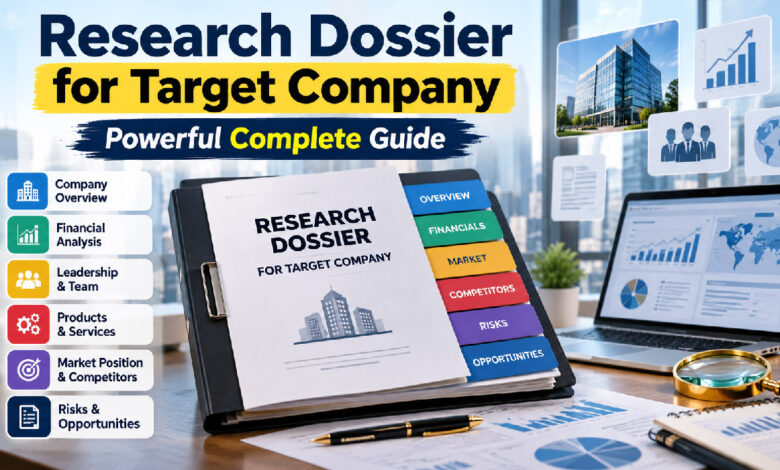
A research dossier for target company is a structured collection of information used to understand a business in detail. It brings important facts about the company into one organized document instead of leaving researchers to work through scattered websites, reports, filings, news stories, and databases. A useful dossier can cover corporate identity, history, products, leadership, customers, financial performance, competitors, risks, ownership, and future plans.
The purpose of a research dossier is not simply to collect as much information as possible. Its real purpose is to turn reliable information into knowledge that supports a specific decision. Investors may use a dossier before considering an investment, while sales teams can use one before approaching a major prospect. Consultants, business owners, analysts, procurement teams, and strategic planners can also use company dossiers for different research needs.
Creating a detailed dossier requires more than searching for a company name and copying available information. Researchers need to identify trustworthy sources, check dates, separate facts from estimates, compare evidence, and understand why each finding matters. This guide explains how to create a detailed research dossier for target company, including company analysis, financial research, competitors, leadership, risks, opportunities, verification methods, and useful research tools.
What Is a Research Dossier for Target Company?
A research dossier for target company is a detailed report containing organized and verified information about a specific business. The “target company” is simply the organization being studied. Depending on the research purpose, it could be a public corporation, private company, startup, manufacturer, retailer, technology business, service provider, potential acquisition target, supplier, customer, or business competitor.
A dossier is more detailed than a normal company profile. A basic profile usually provides information such as the company name, headquarters, founding year, founders, industry, and products. A comprehensive dossier connects those basic details with information about revenue generation, financial performance, customers, leadership, competitors, ownership, market conditions, risks, strategic developments, and possible growth opportunities.
The value of the document comes from both evidence and analysis. Knowing that a company launched a new product is a fact, but a researcher can go further by examining its intended customers, competitors, pricing, distribution, and potential importance to the business. This connection between reliable information and useful interpretation is what makes a research dossier valuable for decision-making.
Why a Target Company Research Dossier Is Important
Business information is often spread across many sources. Important facts can appear on corporate websites, investor relations pages, regulatory filings, annual reports, government databases, press releases, executive interviews, industry publications, and reputable news organizations. A dossier creates one organized location where these findings can be reviewed together and traced back to their original sources.
Structured research can also reduce mistakes. Someone relying on a quick internet search might find an old employee count, previous CEO, outdated financial figure, or incorrect ownership information. A properly maintained research dossier records dates and reporting periods and encourages important claims to be checked against authoritative evidence. This makes it easier to distinguish current information from historical information.
A research dossier can support many decisions. Investors may examine financial strength and growth potential, while sales professionals may study company priorities and decision-makers. Consultants can use company intelligence when developing recommendations, and business development teams can evaluate partnership opportunities. The information required may change according to the objective, but the underlying principle remains the same: better evidence supports better-informed decisions.
Define the Research Objective Before Starting
Every research dossier for target company should begin with a clear objective. Without one, researchers can spend hours collecting interesting information that has little connection to the actual decision. A good objective explains why the company is being studied and identifies the main questions that the finished dossier needs to answer.
For investment research, important questions might involve revenue growth, profitability, debt, cash flow, market position, management, competitive advantages, and major risks. Sales research may focus instead on company size, business problems, technology, expansion plans, executives, purchasing needs, and recent developments. Acquisition research can require much deeper examination of ownership, operations, liabilities, customers, financial statements, and strategic fit.
Writing down these questions before research begins creates a practical checklist. It also establishes boundaries around the project. Researchers can then judge every piece of information by asking whether it helps answer an important question. This approach keeps the dossier relevant and prevents it from becoming a long collection of disconnected company facts.
Target Company Overview and Corporate Identity
The company overview establishes exactly which business is being researched. It should record the official company name, legal entity where available, brand names, official website, headquarters, founding year, founders, industry, ownership type, and major geographic markets. Parent companies and important subsidiaries should also be identified when they are relevant.
Identity verification is particularly important when several businesses have similar names. Information about one organization can easily be confused with another if researchers rely only on broad search results. The company’s official domain, registered name, industry, headquarters, regulatory records, and other identifying details can help confirm that information belongs to the correct organization.
This section should also explain what the business actually does. A concise description of its main products, services, customers, and markets gives readers the context needed for later sections. Avoid simply copying promotional descriptions from the company website. Statements such as “industry-leading” or “best” are marketing claims unless independent evidence supports them.
Company History and Important Milestones
A company’s history provides context for understanding its present position. Research should begin with its foundation and then identify developments that materially changed the organization. Important milestones may include major product launches, acquisitions, mergers, funding rounds, geographic expansion, new business divisions, rebranding, restructuring, partnerships, public listings, or significant leadership changes.
Dates are important when documenting these developments. Arranging milestones chronologically allows readers to see how the company changed over time. For example, an acquisition may explain why the company entered a new market, while a funding round may show how expansion was financed. Historical events become more useful when their relationship with later business developments is clear.
A company history should remain relevant rather than becoming a biography containing every available event. Concentrate on developments that affected ownership, scale, products, markets, leadership, or business strategy. When possible, verify important milestones using corporate announcements, filings, government records, or reliable independent reporting rather than repeating unsourced timelines from third-party websites.
Target Company Business Model and Revenue Sources
Understanding how the business makes money is one of the most important parts of a research dossier for target company. Start by identifying what the company sells, who pays for it, why customers buy it, and how products or services reach those customers. These questions reveal the commercial structure behind the organization.
Revenue can come from direct product sales, subscriptions, licensing, advertising, commissions, transaction fees, professional services, memberships, marketplaces, franchising, or several sources at once. Researchers should determine which revenue streams are most important whenever reliable information is available. For companies with recurring revenue, retention and subscription patterns can also be relevant.
The business model should be considered alongside operating requirements. A manufacturer may depend heavily on factories, raw materials, inventory, suppliers, and distribution networks. A software company may depend more on product development, cloud infrastructure, subscriptions, and customer retention. Understanding these relationships helps explain both the company’s strengths and the operational risks it faces.
Products, Services, and Customer Value
The products and services section should explain the company’s major offerings without turning into advertising copy. For each important offering, researchers should identify what it does, the problem it addresses, the customers it serves, how it is delivered, and how it contributes to the broader business.
Product research can also examine pricing when publicly available, major features, recent updates, distribution methods, and competing alternatives. A product may be strategically important even when its direct revenue contribution is unclear. For example, it might help the company enter a new market, attract another customer segment, or strengthen an existing product ecosystem.
Researchers should also watch for changes in the portfolio. New launches, discontinued products, acquisitions, and repositioning can reveal changes in company strategy. However, announced products and future plans should be clearly distinguished from products already available to customers. This prevents corporate expectations from being presented as established business results.
Customers, Markets, and Geographic Reach
Customer analysis identifies who buys the company’s products or services. A business may serve individual consumers, small companies, large enterprises, governments, educational organizations, healthcare providers, or several groups. Understanding these customer segments helps explain demand and how the company positions its offerings.
Geographic analysis is equally important. Researchers should identify the countries, regions, or markets where the business operates when reliable information is available. International expansion can create additional growth opportunities, but it can also introduce currency exposure, regulation, logistical complexity, taxation issues, and differences in customer behavior.
Customer concentration deserves special attention. A business that receives a significant percentage of revenue from a small number of customers can face additional risk if one customer reduces spending or ends the relationship. Researchers should only report concentration figures when supported by reliable evidence and should avoid guessing about customers that the company has not publicly disclosed.
Financial Performance and Revenue Analysis
Financial performance helps researchers understand the economic condition of a company. Relevant measures can include revenue, year-over-year growth, gross profit, operating income, EBITDA, net income, margins, cash flow, capital expenditure, assets, liabilities, and debt. The exact metrics required depend on the company’s industry and the purpose of the research.
Every financial figure should include the relevant period. A revenue number without a year or quarter can quickly become misleading. Researchers should also avoid evaluating a company based only on revenue growth. Sales may increase while operating expenses, debt, losses, or cash requirements rise even faster. Multiple financial measures provide a more complete picture.
Public companies generally provide more financial information through annual reports, quarterly reports, earnings releases, and regulatory filings. Private-company information can be considerably more limited. Third-party databases may provide estimates for private businesses, but estimates should be clearly labeled and should never be presented as audited or officially reported financial results.
Financial Health, Cash Flow, and Debt
Financial health goes beyond revenue and accounting profit. Cash flow shows whether a company’s operations generate sufficient cash and how money moves through the organization. Researchers can examine operating cash flow, investing activities, financing activities, and free cash flow when these figures are available and relevant.
Debt is another important consideration. The amount of debt alone does not provide a complete assessment. Researchers should consider the company’s ability to service its obligations, available cash, interest costs, maturity schedules, and overall capital structure. A business with significant debt may still be financially stable if its cash generation comfortably supports those commitments.
For startups and rapidly growing private businesses, burn rate and runway can sometimes be important, although reliable figures may not be publicly disclosed. Funding dependency should also be considered carefully. A growing business that continually requires external capital faces different financial conditions from one capable of funding expansion through internally generated cash.
Funding, Investors, and Ownership Structure
Ownership research explains who controls or financially supports the company. Depending on the organization, this may include founders, families, institutional shareholders, venture capital firms, private equity funds, strategic investors, governments, or a parent corporation. Public-company filings can often provide detailed information about significant shareholders.
Startup research may include seed funding, Series A and later financing rounds, investors, reported valuations, and the total capital raised. Funding announcements can reveal how a business intends to finance expansion, hiring, product development, acquisitions, or entry into new markets. However, funding received should not be confused with revenue or profit.
Ownership can also affect strategic decisions. A founder-controlled company, venture-backed startup, private-equity-owned business, and widely held public corporation can have very different governance structures and priorities. The dossier should describe documented ownership relationships while avoiding unsupported assumptions about the intentions of individual shareholders or investors.
Leadership Team and Organizational Structure
Leadership research should identify executives who have meaningful responsibility for the company’s direction. Depending on the business, this may include founders, the CEO, CFO, COO, CTO, division leaders, and board members. Their current positions, tenure, professional background, and relevant industry experience can provide useful strategic context.
Changes in leadership may deserve particular attention. The arrival of a new CEO or CFO can coincide with restructuring, acquisitions, cost reductions, international expansion, or another strategic shift. Researchers should avoid assuming causation, however. Leadership changes should be connected to strategy only when credible evidence supports that relationship.
The organizational structure can include subsidiaries, operating divisions, business segments, geographic units, and employee information. Hiring or layoffs can provide additional context about company development, but headcount changes should not automatically be treated as evidence of success or failure. Their significance depends on the company’s broader financial and operational circumstances.
Industry Landscape and Market Position
No business should be analyzed in isolation. A research dossier for target company should examine the industry in which the organization operates. Relevant factors include market size, expected growth, customer demand, technology changes, regulation, economic conditions, industry maturity, and barriers that make entry easier or harder for new competitors.
Market position describes where the company sits within this environment. Researchers may consider customer reach, geographic presence, product range, market share when reliable data exists, pricing position, distribution strength, and brand recognition. Claims of market leadership should be supported by evidence rather than repeated from promotional materials.
Industry conditions can also change the meaning of company results. A company growing 10 percent in a market expanding 30 percent may be losing relative ground, while modest growth in a declining industry could indicate resilience. Comparing company performance with broader market trends therefore provides important context.
Competitor Analysis and Competitive Position
Competitor research should identify both direct and indirect alternatives. Direct competitors generally provide similar solutions to similar customers, while indirect competitors solve the same underlying problem differently. This distinction helps create a more realistic picture of the competitive environment.
Useful comparison factors include products, pricing, customer groups, geographic coverage, distribution, business models, technology, market positioning, and scale. The objective is not simply to create a list of company names. Researchers should explain where the target company differs from competitors and why those differences could matter to customers.
Competitive information must also remain current. Products, prices, strategies, and market positions can change quickly. Important comparisons should therefore include dates where appropriate. A competitor analysis becomes substantially more valuable when it explains the basis of comparison instead of making unsupported claims about which business is “better.”
Competitive Advantage and Economic Moat
A competitive advantage is a factor that helps a business perform differently from rivals. Possible advantages include a trusted brand, proprietary technology, patents, exclusive relationships, efficient operations, lower costs, distribution strength, customer loyalty, valuable data, network effects, or specialized expertise.
An economic moat is stronger than a temporary advantage because it can make successful competition more difficult over an extended period. Examples can include high switching costs, economies of scale, strong network effects, intellectual property, regulatory advantages, or deeply established distribution systems. Not every successful company has a durable moat.
Researchers should test claimed advantages instead of accepting them automatically. A popular product can attract competitors, a patent eventually expires, and customer loyalty can weaken. A strong dossier examines whether an advantage is difficult to reproduce, how long it might remain useful, and what developments could reduce its value.
Recent Developments and Strategic Changes
Recent events can materially change an otherwise accurate research dossier. Researchers should therefore review acquisitions, funding rounds, product launches, partnerships, executive changes, restructuring, layoffs, geographic expansion, regulatory developments, lawsuits, and major financial announcements.
Priority should be given to developments that can meaningfully affect the business. Minor corporate announcements may add volume without adding insight. For every significant development, researchers should identify what happened, when it happened, the evidence supporting it, and why it may matter to the company’s operations or strategy.
Recent news should also be verified carefully. Initial reports can contain incomplete information, and corporate announcements naturally reflect the company’s own perspective. Where the matter is significant, compare official statements with regulatory records or credible independent reporting before reaching conclusions.
Risk Analysis and Business Challenges
Every research dossier for target company should include risk analysis. Common categories include financial, operational, competitive, legal, regulatory, cybersecurity, technological, supply-chain, customer concentration, reputational, and macroeconomic risks. The relevant categories will depend on the company’s industry and business model.
Risks should be based on evidence rather than imagination. For example, documented reliance on a small number of suppliers can support supply-chain concerns, while substantial debt can create financial considerations. Researchers should explain the evidence, possible business impact, and level of uncertainty instead of merely producing a generic list of threats.
Risk also needs context. A factor that creates serious exposure for one company may be manageable for another because of stronger finances, diversification, insurance, alternative suppliers, or other protections. A useful risk assessment therefore considers both the potential problem and the company’s ability to manage it.
Growth Opportunities and Future Strategy
Growth analysis considers realistic ways a company could expand. Opportunities may include new geographic markets, additional products, new customer groups, acquisitions, strategic partnerships, cross-selling, improved distribution, pricing changes, or technological development. Each opportunity should be connected to evidence rather than presented as guaranteed future growth.
Company-announced plans can provide useful information about management priorities. However, an announced expansion strategy is not the same as successful execution. Researchers should clearly separate what management plans to do from what has already been achieved and from their own assessment of what could happen.
Market conditions should also be considered. An attractive opportunity may require significant investment, face powerful competitors, or depend on regulatory approval. Evaluating both the potential benefit and practical obstacles produces a more balanced view of the company’s future possibilities.
Reliable Sources for Target Company Research
Source quality directly affects dossier quality. Primary sources should normally receive priority for important company facts. These can include official company websites, investor relations pages, annual reports, regulatory filings, government records, earnings releases, corporate governance documents, product documentation, and official press releases.
Independent sources can provide additional context and verification. Established financial news organizations, respected industry publications, academic research, market research firms, and reputable business databases can help researchers understand developments that corporate materials may describe from a different perspective.
Researchers should be cautious with anonymous blogs, copied articles, outdated database entries, forums, search snippets, and unsourced AI-generated statements. Even a professional-looking website can contain incorrect information. Important financial, legal, ownership, leadership, and strategic claims should be traced back to credible evidence whenever possible.
Facts, Estimates, and Analysis
A professional research dossier must distinguish facts from estimates and interpretation. A fact is information supported by reliable evidence, such as revenue reported in an audited annual report. An estimate is a calculated or reported figure that has not necessarily been confirmed by the company.
Analysis is different again. It represents an interpretation of available evidence. For example, a filing may confirm that a company receives substantial revenue from one customer. The possibility that losing that customer could materially affect revenue is analysis based on the disclosed fact.
Clear language helps maintain these distinctions. Phrases such as “the company reported,” “the filing states,” “industry estimates suggest,” and “available evidence indicates” tell readers how certain the information is. This improves transparency and makes future updates easier when stronger evidence becomes available.
How AI Can Support Company Research
Artificial intelligence can make company research faster by helping researchers organize large amounts of information. AI can summarize lengthy reports, extract important points from documents, compare information, organize timelines, identify research gaps, classify risks, and help draft concise summaries from already collected evidence.
AI is particularly useful when researchers have many documents to review, but it should not become the final authority for important claims. AI systems can misunderstand context, use outdated information, combine unrelated facts, or produce statements that sound convincing without sufficient evidence.
The safest workflow combines AI efficiency with human verification. Researchers can use AI to process and organize information, then check financial figures, executive positions, ownership details, legal matters, and other consequential claims against authoritative sources. AI should support the research process rather than replace source verification.
Building an Evidence and Source Log
A source log makes a research dossier easier to verify, update, and audit. For every important source, record its title, publisher or organization, URL or document location, publication date, access date when relevant, and the specific claim it supports.
Researchers can also classify sources as primary or secondary and note their reliability. A regulatory filing supporting a financial number carries different evidentiary weight from an anonymous web article repeating the same number. Recording this difference helps readers understand why particular claims deserve confidence.
Source logs become particularly valuable over time. When a company releases new financial results or changes leadership, researchers can quickly identify which sections require updates. Instead of starting again, they can replace outdated evidence while retaining historical information that remains useful.
Common Research Dossier Mistakes to Avoid
One of the most common mistakes is collecting too much information without deciding why it matters. Length alone does not make a dossier valuable. Every major section should answer a research question or help readers understand the company, its environment, or a decision connected with it.
Another problem is using outdated or poorly sourced information. Leadership positions, employee numbers, revenue, ownership, products, funding, and market conditions can change. Researchers should attach dates to time-sensitive information and avoid presenting old figures as if they describe the company’s current situation.
Other mistakes include copying marketing language, treating estimates as confirmed facts, relying completely on AI, ignoring competitors, confusing parent companies with subsidiaries, and hiding information gaps. A professional dossier should openly state when reliable information is unavailable instead of filling missing areas with unsupported assumptions.
Research Dossier for Target Company Template
A practical dossier can begin with the research objective and executive summary, followed by company identification, history, ownership, leadership, products, services, business model, customers, geographic markets, and revenue sources. This establishes what the organization is and how it operates.
The middle portion can cover financial performance, financial health, funding, investors, industry conditions, market position, direct and indirect competitors, competitive advantages, technology, strategic partnerships, and recent developments. These sections explain how the company performs within its broader business environment.
The final portion should cover SWOT analysis, major risks, growth opportunities, research limitations, evidence sources, final findings, and recommended next research steps. The structure can be shortened for sales research or expanded significantly for investment and acquisition projects. The purpose of the research should determine the required depth.
Research Dossier vs Due Diligence
A company research dossier and due diligence are related but should not automatically be treated as the same process. A dossier organizes available information and analysis to create a detailed understanding of a company. It can be prepared for research, sales, competitive intelligence, investment screening, partnerships, or strategic planning.
Formal due diligence usually involves deeper verification connected with a consequential transaction or decision. Depending on the situation, it can include detailed financial, legal, tax, operational, commercial, cybersecurity, environmental, or technical reviews conducted by qualified specialists with access to information that may not be publicly available.
A strong research dossier can therefore become an important starting point for due diligence, but it does not necessarily replace it. The dossier can identify important questions, potential risks, missing information, and areas requiring specialist investigation before a major transaction proceeds.
How Often Should a Research Dossier Be Updated?
A research dossier should be treated as a living resource when the target company remains important. Some information, such as the founding year, changes rarely, while financial results, executives, ownership, products, pricing, partnerships, employee counts, legal developments, and market conditions can change frequently.
The appropriate update schedule depends on the research purpose. A company being actively considered for investment, acquisition, partnership, or a major contract may require frequent monitoring. A business used only for general market research may need updates less often.
Recording a “last verified” date for important information makes maintenance easier. Historical data should not necessarily be deleted when new information appears. Keeping dated records allows researchers to see how financial performance, leadership, products, ownership, and strategy have changed over time.
Final Evaluation of a Target Company
The final evaluation should bring the evidence together instead of simply repeating previous sections. It should identify the company’s most important strengths, weaknesses, opportunities, risks, competitive position, financial characteristics, strategic direction, and unresolved questions.
Researchers should also identify limitations. Some private companies disclose little financial information, market-share estimates may vary between sources, and future strategies remain uncertain until executed. Stating these limitations makes the analysis more credible because readers understand where evidence is strong and where uncertainty remains.
The final assessment should return to the original research objective. If the dossier was created for investment screening, it should identify the areas requiring further financial or legal investigation. If it was created for sales, partnerships, or competitive analysis, the final findings should focus on the information most relevant to that specific decision.
Conclusion
A research dossier for target company turns scattered business information into a structured source of evidence and analysis. A strong dossier covers company identity, history, business model, products, customers, financial performance, ownership, leadership, competitors, market position, risks, growth opportunities, recent developments, and supporting sources.
The quality of a dossier depends more on accuracy than length. Reliable primary sources, credible independent evidence, current information, clear reporting periods, and careful separation of facts from estimates all improve the usefulness of company research. Important gaps should be acknowledged rather than filled with guesses.
When prepared correctly, a research dossier becomes a practical decision-support tool for investors, analysts, business owners, consultants, sales professionals, and strategic teams. Combining structured research with careful verification and thoughtful analysis makes it easier to understand a target company, recognize important risks and opportunities, and determine what research should happen next.
(FAQs)
What is a research dossier for target company?
A research dossier for target company is a detailed report that collects important information about a business, including its financial performance, leadership, products, competitors, customers, risks, ownership, and growth opportunities.
What should a target company research dossier include?
It should include company background, business model, products, leadership, financial results, customers, competitors, market position, funding, ownership, recent developments, business risks, growth opportunities, and reliable information sources.
How do you create a research dossier for target company?
Start by identifying the research goal. Collect information from reliable sources, study the company’s business model and finances, analyze competitors and risks, verify important facts, and organize the findings into clear sections.
Why is a research dossier for target company important?
A research dossier helps investors, analysts, sales teams, consultants, and business owners understand a company before making important decisions. It organizes useful evidence and highlights the company’s strengths, weaknesses, risks, and opportunities.
Can AI help create a target company research dossier?
Yes. AI can summarize reports, organize research, compare competitors, and identify missing information. However, important financial, legal, ownership, and company information should always be checked against reliable and authoritative sources.