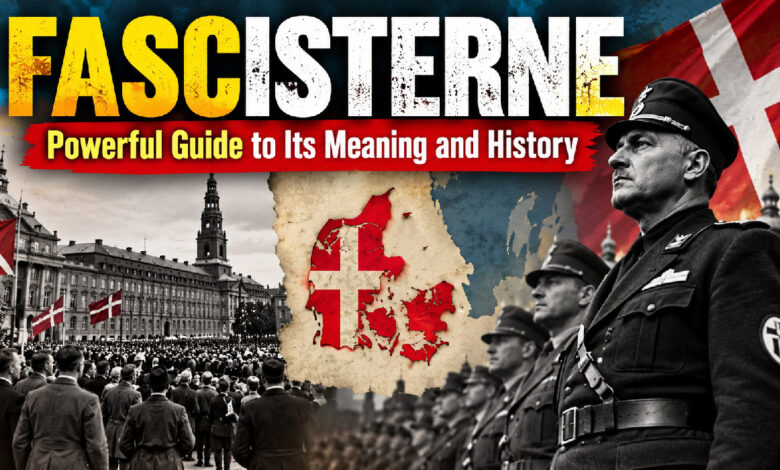
Fascisterne is a Danish word that translates directly to “the fascists” in English. It refers to a specific group of people who support fascism, belong to a fascist movement, or are identified with fascist political ideas. The word describes people rather than the political ideology itself.
In Danish grammar, the singular word is fascist, while fascister means “fascists.” Adding the definite ending creates fascisterne, meaning “the fascists.” The related Danish word fascisme means “fascism,” which describes the ideology rather than its supporters. This distinction is important when translating Danish political or historical material.
The meaning of fascisterne can also depend on context. In a discussion about Italy, it might refer to supporters of Benito Mussolini. In Danish historical writing, it could describe Danish fascists or other fascist movements. Therefore, readers should examine the country, political movement, and historical period being discussed.
Fascisterne in Danish Grammar
Understanding Danish grammar makes the meaning of fascisterne much clearer. Danish commonly changes the ending of a noun to show whether it is singular, plural, definite, or indefinite. The basic word fascist describes a person who supports fascist ideology or belongs to a fascist political movement.
The plural form is fascister, meaning “fascists.” Fascisterne is the definite plural and therefore means “the fascists.” A useful comparison is fascist for “a fascist,” fascisten for “the fascist,” fascister for “fascists,” and fascisterne for “the fascists.” These forms identify people rather than the ideology.
Another important word is fascisme, which means “fascism.” Fascistisk can be translated as “fascist” or “fascistic” when it is used descriptively. Understanding these differences prevents a common translation error: fascisterne should generally not be translated simply as “fascism.”
Where Does the Word Fascisterne Come From?
The deeper history behind fascisterne leads from Danish through Italian and eventually to ancient Latin. The modern political term fascism comes from the Italian word fascismo. This was connected with fascio, an Italian word that can refer to a bundle, group, league, or association.
The Italian term itself has a connection with the Latin fascis. In ancient Rome, fasces were bundles of wooden rods, sometimes surrounding an axe. Roman officials were accompanied by attendants carrying them, and the fasces became an important symbol of public authority and governmental power.
Centuries later, Italian political movements adopted language and symbolism connected with the fascio. Benito Mussolini’s movement transformed these associations into the modern political term fascism. Danish, like many European languages, developed corresponding words, including fascisme, fascist, fascister, and fascisterne.
What Is Fascism?
Fascism is a political ideology and historical movement associated with extreme nationalism, authoritarian political power, opposition to liberal democracy, and the belief that collective national interests should take priority over competing individual or group interests. Historical fascist movements generally rejected normal democratic political competition.
There is no single characteristic that identifies every fascist movement by itself. Historical movements differed between countries and changed over time. However, scholars commonly examine combinations of features such as ultranationalism, authoritarian leadership, political violence, mass mobilization, hostility toward political pluralism, militarism, and attempts to create national unity.
This distinction is important when understanding fascisterne. A person does not automatically become a fascist simply by being nationalist, conservative, authoritarian, or supportive of a powerful government. Historical classification requires examining a movement’s broader ideology, political organization, methods, goals, and attitude toward democratic institutions.
How Fascism Developed in Europe
Modern fascism developed in Europe during the political and social instability surrounding World War I and its aftermath. The war had caused enormous destruction and loss of life. Several European societies faced inflation, unemployment, political instability, revolutionary movements, class conflict, and widespread dissatisfaction with existing governments.
Many people feared communist revolution following the Russian Revolution of 1917. Others believed traditional political institutions were unable to restore stability or national strength. Radical nationalist movements attempted to use these anxieties by promising unity, discipline, strong leadership, and national renewal.
Economic hardship alone did not create fascism. Fascist movements developed from particular political ideas combined with specific historical circumstances. They deliberately organized supporters, challenged democratic institutions, mobilized nationalist sentiment, and in many cases used intimidation or violence against their political opponents.
Benito Mussolini and the Rise of Italian Fascism
Benito Mussolini became the central figure in the development of Italian Fascism. In 1919, he established the Fasci Italiani di Combattimento in Milan. The movement attracted nationalists, war veterans, anti-socialists, and others dissatisfied with Italy’s political and social situation following World War I.
Fascist squads commonly known as Blackshirts became notorious for political violence. They attacked socialist organizations, trade unions, political offices, and opponents. Violence and intimidation were therefore not accidental features surrounding Italian Fascism; they became important instruments in the movement’s struggle for political influence.
In October 1922, Fascists organized the March on Rome. King Victor Emmanuel III subsequently appointed Mussolini prime minister. Italy did not instantly become a complete dictatorship, but Mussolini progressively destroyed democratic restraints, suppressed political opposition, restricted independent journalism, and created an authoritarian Fascist regime.
What Did Historical Fascisterne Believe?
Historical fascist movements differed significantly, meaning there was no perfectly identical set of beliefs followed by every person described as fascisterne. Nevertheless, many movements shared a powerful form of nationalism in which national unity, strength, and collective identity were placed above political disagreement and competing individual interests.
Fascist movements generally rejected liberal democracy and political pluralism. Instead of treating opposition parties as legitimate competitors, fascist movements frequently portrayed opponents as obstacles or enemies threatening national unity. Political authority increasingly became concentrated around a ruling movement and a powerful leader presented as representing the nation.
Fascism also emphasized action, discipline, sacrifice, hierarchy, and national strength. Several movements celebrated military values and accepted political violence. Propaganda, organized rallies, uniforms, symbols, youth movements, speeches, newspapers, radio, and public ceremonies were used to create loyalty and mobilize large numbers of people.
Nationalism and the Fascist Idea of Unity
Nationalism was central to historical fascism, but fascist nationalism went beyond ordinary attachment to one’s country. Fascist movements promoted an intense form of national identity in which the nation was treated as an organic community requiring unity, discipline, strength, and sometimes territorial expansion.
Political disagreement could consequently be portrayed as weakness or betrayal. Fascist movements often argued that divisions between political parties, social classes, and other groups damaged the nation. They promised to replace such divisions with a unified national community operating under centralized political leadership.
This idea could also create powerful divisions between those considered genuine members of the nation and those portrayed as outsiders. Depending on the particular movement, ethnic, religious, political, or social groups could be excluded, blamed for national problems, persecuted, or presented as threats.
Fascisterne and Authoritarian Leadership
Strong leadership was another major characteristic of fascist politics. Fascist movements commonly rejected the idea that political authority should continually be negotiated among competing parties. Instead, they promoted centralized leadership capable of acting without the limitations normally created by democratic political competition.
The leader could become much more than an ordinary government official. Fascist propaganda often presented the leader as the embodiment of national unity, strength, destiny, and renewal. Mussolini’s public image as Il Duce, meaning “the leader,” became an important example of this leader-centered political culture.
Under such systems, independent institutions could gradually lose their ability to restrain political power. Opposition parties could be prohibited, newspapers censored, critics intimidated, and public organizations placed under government influence. These changes allowed authoritarian regimes to reduce meaningful political competition.
Propaganda, Symbols, and Mass Mobilization
Fascist movements understood the political power of mass communication. Propaganda was used not simply to provide information but to shape public attitudes, create emotional loyalty, identify enemies, and promote an idealized image of the nation and its political leadership.
Large rallies, banners, uniforms, slogans, architecture, newspapers, radio broadcasts, films, speeches, and political symbols helped create a sense of collective identity. Youth organizations could introduce younger generations to the movement’s worldview, while public ceremonies presented discipline and political unity as signs of national strength.
These techniques show why studying fascisterne involves more than examining government laws. Historical fascist movements attempted to influence political culture and everyday attitudes. They wanted supporters to participate emotionally in the movement rather than simply obey government decisions.
Political Violence and the Suppression of Opposition
Violence played an important role in several historical fascist movements. Paramilitary organizations could intimidate opponents, disrupt political meetings, attack labor organizations, and create an atmosphere in which political disagreement carried serious personal risks.
Once fascist movements gained governmental power, repression could become institutionalized. Censorship, surveillance, arrests, imprisonment, restrictions on political organizations, and government control over public life could be used to eliminate effective opposition and prevent independent political organization.
Political violence also carried an ideological meaning. Some fascist movements portrayed conflict, struggle, sacrifice, and force as positive forces capable of strengthening or renewing society. This acceptance of political violence helps distinguish historical fascism from ordinary democratic movements that operate within competitive constitutional politics.
Fascism and Anti-Communism
Historical fascisterne were generally strongly opposed to communism and Marxist socialism. The Russian Revolution and the growth of communist movements created significant fear among business owners, landowners, conservative groups, nationalists, and sections of the European middle class during the interwar period.
Fascists rejected the Marxist idea that society should be understood primarily through class struggle between workers and property-owning classes. Fascist movements instead claimed that different social groups should be united under a common national identity and subordinated to wider national objectives.
Anti-communism consequently became an important recruiting and political tool. However, fascism cannot be defined simply as anti-communism. Many political movements opposed communism without being fascist. Fascism combined anti-communism with a broader authoritarian, ultranationalist, anti-liberal, and mobilizing political project.
Fascisterne vs. Nazisterne
Fascisterne and Nazisterne are related Danish terms, but they do not mean exactly the same thing. Fascisterne means “the fascists,” while Nazisterne means “the Nazis.” Fascism describes a broader family of historical movements, whereas Nazism specifically refers to National Socialism associated particularly with Adolf Hitler and Germany’s Nazi Party.
Nazism shared major characteristics with other forms of fascism, including authoritarian leadership, extreme nationalism, opposition to liberal democracy, political repression, propaganda, militarism, and acceptance of political violence. For these reasons, Nazism is generally classified within the broader historical category of fascism.
However, Nazi ideology placed especially fundamental emphasis on racial hierarchy, antisemitism, supposed Aryan racial superiority, and territorial expansion through Lebensraum. Nazi racial ideology ultimately contributed to systematic persecution and genocide, including the Holocaust. Therefore, “fascist” and “Nazi” should not simply be treated as interchangeable labels.
Fascisterne in Denmark
Denmark developed its own fascist and National Socialist organizations during the interwar years. However, these movements never achieved the level of popular support enjoyed by Fascists in Italy or National Socialists in Germany. Denmark therefore did not become a fascist state through the electoral rise of a domestic fascist party.
Political extremism nevertheless existed. Danish political authorities also attempted during the 1930s to limit some forms of organized political violence and militarized political activity. This period must be understood against the wider European background in which fascist, communist, democratic, conservative, and other movements competed for influence.
The Danish history of fascisterne became particularly important after neighboring Nazi Germany occupied Denmark during World War II. Danish National Socialists, collaboration, resistance, German occupation authorities, and ordinary Danish citizens became part of a complicated wartime history that cannot accurately be reduced to a single political category.
DNSAP and Danish National Socialism
The best-known Danish National Socialist organization was Danmarks Nationalsocialistiske Arbejderparti, usually abbreviated as DNSAP. It was founded in 1930 and was strongly influenced by Adolf Hitler’s National Socialist German Workers’ Party in Germany. Cay Lembcke was an early leader of the Danish organization.
Frits Clausen became DNSAP’s leader in 1933. Under his leadership, the organization developed into Denmark’s most prominent National Socialist party. It promoted nationalism, anti-communism, antisemitism, opposition to parliamentary democracy, and political ideas strongly influenced by German National Socialism.
Despite its organization and visibility, DNSAP never gained broad electoral support. It won only a small share of Danish votes and never formed the national government. This is an important historical distinction because the existence of Danish Nazis does not mean Denmark itself became governed by a domestic Nazi party.
Fascisterne During the German Occupation of Denmark
Nazi Germany invaded Denmark on 9 April 1940. Denmark surrendered after a short military confrontation, beginning an occupation that lasted until May 1945. Danish political institutions initially continued operating under unusual conditions while German authorities exercised decisive power over the occupied country.
DNSAP hoped the occupation would create an opportunity to gain greater political influence. However, the Germans did not simply hand Denmark’s government to the Danish Nazi party. DNSAP lacked broad public support, and its close relationship with the occupying German power created an obvious contradiction with its claims of Danish nationalism.
Some Danish National Socialists collaborated with German authorities, and some Danish volunteers served in German military formations. However, historical categories must be used carefully. Not every collaborator belonged to DNSAP, not every Danish Nazi performed identical activities, and collaboration could involve different motives and circumstances.
Danish Resistance and the Rescue of Danish Jews
Resistance against German occupation grew as the war continued. Danish resistance activities included underground newspapers, intelligence gathering, sabotage, assistance to Allied interests, and other efforts intended to challenge German control. Resistance developed gradually rather than appearing as one unified nationwide organization immediately after the invasion.
A particularly important episode occurred in 1943 when German authorities prepared action against Denmark’s Jewish population. Warnings reached Danish Jews, and a large rescue effort developed. Danish citizens and resistance networks helped thousands of Jews escape across the water to neutral Sweden.
Most Danish Jews successfully escaped deportation, making the rescue one of the best-known episodes of Denmark’s wartime history. It nevertheless existed within a wider and complicated occupation involving cooperation, accommodation, resistance, persecution, political conflict, and changing relations between Danish institutions and German authorities.
What Happened After World War II?
The major fascist and Nazi regimes in Europe collapsed during the final stages of World War II. Mussolini was removed from power in 1943, later headed the German-supported Italian Social Republic, and was killed by Italian partisans in April 1945.
Nazi Germany was defeated in May 1945, and Denmark was liberated from German occupation. DNSAP collapsed as a meaningful political force. Danish authorities subsequently investigated wartime collaboration, with legal consequences depending on individual actions rather than simply applying one identical judgment to everyone associated with wartime cooperation.
Fascist and Nazi ideology did not disappear completely after 1945. Smaller organizations inspired by historical fascism and National Socialism later appeared in Europe and elsewhere. Such postwar movements are commonly described using terms such as neo-fascist or neo-Nazi, depending on their specific beliefs and historical influences.
Fascism Compared With Authoritarianism and Dictatorship
Fascism, authoritarianism, and dictatorship overlap in some areas, but they are not exact synonyms. Authoritarianism broadly describes political systems in which power is concentrated and meaningful political freedom is restricted. Many different ideological systems can therefore be authoritarian without being fascist.
A dictatorship similarly describes a system in which political power is concentrated in one ruler or a small group with limited democratic accountability. Dictatorships can emerge from military rule, personal leadership, monarchy, revolutionary movements, communist systems, fascist movements, or other political arrangements.
Fascism is more specific because it combines authoritarian political practices with a particular ideological tradition involving intense nationalism, political mobilization, opposition to liberal democracy, concepts of national renewal, and other characteristics. Calling every dictatorship fascist therefore removes important historical distinctions.
Fascism Compared With Nationalism, Conservatism, and Populism
Nationalism alone is not fascism. Nationalism can exist within democratic political systems and can take many different forms. Fascist movements historically adopted an extreme, exclusionary, authoritarian form of nationalism combined with other ideological and organizational characteristics.
Conservatism is also not automatically fascist. Conservative parties can operate within constitutional democracy, accept competitive elections, protect political pluralism, and peacefully transfer power. Historical fascists generally rejected important elements of liberal parliamentary democracy rather than simply occupying a conventional position on a democratic political spectrum.
Populism is another separate concept. Populist movements commonly present politics as a conflict between “ordinary people” and an establishment or elite. Populism can appear alongside different left-wing, right-wing, democratic, or authoritarian ideologies. It therefore should not automatically be treated as fascism.
How Is Fascisterne Used Today?
Today, fascisterne continues to appear in Danish historical writing, education, journalism, political analysis, documentaries, books, and online discussions. In a historical context, its meaning is often straightforward because the writer identifies a particular fascist organization, movement, or period.
Modern political discussion can make the term more complicated. People sometimes use words such as “fascist” as broad insults against politicians, governments, organizations, or individuals they strongly dislike. Such rhetorical usage does not necessarily correspond with the historical or scholarly meaning of fascism.
Readers should therefore examine evidence before accepting the label. Important questions include whether a movement rejects democratic pluralism, promotes extreme nationalism, supports authoritarian concentration of power, legitimizes political violence, excludes groups from its national vision, and seeks to eliminate meaningful political opposition.
How to Understand Fascisterne in Context
When encountering fascisterne in a Danish sentence, the best starting point is its direct translation: “the fascists.” Readers should then identify the people being discussed. The surrounding country, date, political organization, and historical event usually make the intended meaning clearer.
For example, a discussion about Mussolini’s Italy may use fascisterne for Italian Fascists. A Danish article about political movements in the 1930s may refer to Danish fascists. A text discussing Nazi Germany may distinguish fascisterne from nazisterne depending on the writer’s terminology and analytical purpose.
Readers should also determine whether the word is being used historically, academically, journalistically, or rhetorically. Historical labels become more useful when supported by evidence about political beliefs, organizations, methods, and goals rather than being based only on emotional disagreement.
Why Understanding Fascisterne Still Matters
Understanding fascisterne is useful because the word connects language with one of the most consequential political periods in modern European history. Learning its exact meaning helps readers understand Danish texts while also preventing confusion between fascism, Nazism, authoritarianism, nationalism, and related political concepts.
Studying historical fascism also shows how political movements can use nationalism, propaganda, mass mobilization, leader-centered politics, intimidation, and hostility toward opposition. Understanding these mechanisms helps readers interpret historical documents and political terminology with greater precision rather than relying on oversimplified labels.
Most importantly, fascisterne should be approached as a historical and political term with a specific linguistic meaning. Using the word accurately preserves distinctions that are necessary for understanding European history, Denmark’s wartime experience, and the development and consequences of fascist political movements.
Bottom Line
Fascisterne is the Danish definite plural of fascist and directly translates as “the fascists.” It describes people associated with fascism, while fascisme describes the political ideology itself. The term is therefore both a straightforward Danish grammatical form and a word carrying substantial historical significance.
Its history leads to the emergence of fascism in post-World War I Italy, Benito Mussolini’s dictatorship, the spread of authoritarian nationalist movements across Europe, and the development of National Socialism in Germany. Denmark also had National Socialist organizations, particularly DNSAP, although they never gained enough public support to govern the country.
Understanding fascisterne requires context. Fascism and Nazism are closely related but not identical, and fascism should not be treated as a synonym for every dictatorship, nationalist movement, conservative party, or authoritarian government. Accurate terminology makes historical and political discussion clearer and more informative.
Frequently Asked Questions
What does Fascisterne mean?
Fascisterne is a Danish word meaning “the fascists” in English. It refers to a specific group of people who support fascism or are associated with fascist political movements.
Is Fascisterne the same as fascism?
No. Fascisterne means “the fascists” and refers to people. The Danish word “fascisme” means fascism, which is the political ideology associated with authoritarianism and extreme nationalism.
What is the difference between Fascisterne and Nazisterne?
Fascisterne means “the fascists,” while Nazisterne means “the Nazis.” Nazism is generally classified as a form of fascism, but it developed a particularly strong racial and antisemitic ideology.
Did Fascisterne rule Denmark?
No Danish fascist party ruled Denmark. Nazi Germany occupied Denmark from 1940 to 1945, but the Danish National Socialist party DNSAP never gained enough public support to form the government.
Is Fascisterne still used today?
Yes. Fascisterne is still used in Danish historical writing, education, journalism, and political discussions. Its exact meaning depends on the group, historical period, and context being discussed.